


Memristive Spiking Neural Networks State-Dependent STDP and Analog Hardware Privacy
Neuromorphic engineers have long pitched memristive spiking neural networks (SNNs) as the closest synthetic analog to biological synapses, because a nanoscale memristor stores synaptic weight directly as physical electrical conductance where spikes arrive. Two arXiv preprints announced on November 3, 2026 examine the flip side of moving learning out of clean digital memory and into real analog device physics. In State-Dependent Memristor Dynamics for Device-Informed Spike-Timing-Dependent Plasticity in Spiking Neural Networks (arXiv:2611.00119), Samiur Rahman Khan (University of Cincinnati) and Saifur Rahman Sabuj (BRAC University) model how physical conductance bounds reshape local learning rules. In parallel, Pablo Sorrentino, Fernando M. Quintana, Erika Covi, and Fatih Turkmen at the University of Groningen and Technical University of Munich publish Hardware-Aware Model Inversion in Memristive Spiking Neural Networks (arXiv:2610.39688), testing how analog device variability and neuron-threshold perturbations alter information leakage and privacy in memristive accelerators.
Together, these two November 2026 studies show that physical neuromorphic substrates introduce both device-level learning constraints and unexpected information-theoretic side effects that never appear in idealized software simulations.
Device-Informed STDP When Synapses Have Physical Limits
In textbook Spike-Timing-Dependent Plasticity (STDP), synaptic weight changes depend solely on the relative arrival time of pre-synaptic and post-synaptic spikes. Real nanoscale memristors do not behave like ideal linear integrators. Their conductance updates are state-dependent, nonlinear, asymmetric between potentiation and depression, and bounded by physical filament geometry.
Khan and Sabuj (arXiv:2611.00119) incorporate a threshold-memristor physical model directly into STDP updates rather than treating hardware non-idealities as an afterthought. By making plasticity explicitly aware of each device’s current conductance state, their spiking network accommodates nonlinear switching kinetics and evaluates resilience against hardware faults. This mirrors a wider 2026 trend across neuromorphic platforms such as BrainScaleS-2 analog neuromorphic substrates and BrainChip’s event-based Akida AKD1500 Pico, where training algorithms must co-adapt to the exact physics of the silicon rather than assuming infinite-precision floating-point weights.
Analog Noise, Neuron Thresholds, and Model Inversion
While device variability is normally treated purely as an accuracy penalty, Sorrentino, Quintana, Covi, and Turkmen (arXiv:2610.39688) examine what analog variability does to data security and privacy inside memristive SNN accelerators. Model-inversion attacks attempt to reconstruct private training inputs from a deployed neural network’s outputs or internal responses.
The Groningen and Munich team evaluates how cycle-to-cycle memristor conductance noise, device-to-device fabrication mismatch, and spiking neuron firing-threshold perturbations affect an attacker’s ability to invert a trained SNN. Their hardware-aware analysis demonstrates that analog non-idealities directly reshape the mutual information between internal spike traces and original sensory inputs. Designing secure edge neuromorphic chips therefore requires modeling physical device noise alongside spiking accuracy, rather than auditing privacy only on idealized digital checkpoints.
| Study (Nov 2026) | Authors & Affiliation | Core Device Phenomenon | Engineering Implication |
|---|---|---|---|
arXiv:2611.00119 |
Samiur Rahman Khan (U. Cincinnati), Saifur Rahman Sabuj (BRAC Univ.) | State-dependent nonlinear threshold-memristor conductance updates | Local STDP learning must be device-informed to stay accurate and fault-tolerant |
arXiv:2610.39688 |
Pablo Sorrentino, Fernando M. Quintana, Erika Covi, Fatih Turkmen (U. Groningen / TUM) | Analog conductance variability, noise, and neuron firing-threshold perturbations | Physical hardware noise alters model-inversion leakage and edge SNN privacy |
What Memristive SNN Physics Tells Us About Consciousness
Every neuromorphic paper on this site must answer what it tells us about consciousness. In the scientific consensus tracked in how scientists race to define and test AI consciousness in 2026 and in J. Mark Bishop and Slawomir J. Nasuto’s critique of computationalism, a core point of contention is whether physical substrate details are mere implementation noise or active contributors to cognitive organization.
Biological synapses exhibit state-dependent saturation, stochastic vesicle release, and local metabolic history that look far closer to Khan and Sabuj’s nonlinear memristors than to 32-bit GPU weight matrices. Likewise, Sorrentino, Covi, and colleagues show that physical analog variability changes how much historical input structure remains recoverable from spiking activity. Under Integrated Information Theory (IIT) and Recurrent Processing Theory, where causal structure depends on physical state transitions rather than only input-output function, a memristive SNN with genuine local in-memory plasticity instantiates a fundamentally different causal architecture from a von Neumann GPU simulating spikes in serial memory.
At the same time, neither paper claims anything about sentience or subjective experience. Showing that memristive synapses can run fault-tolerant local STDP or resist model inversion tests the substrate layer of neuromorphic engineering, not the presence of global workspace broadcasting, affective valence, or self-modeling.
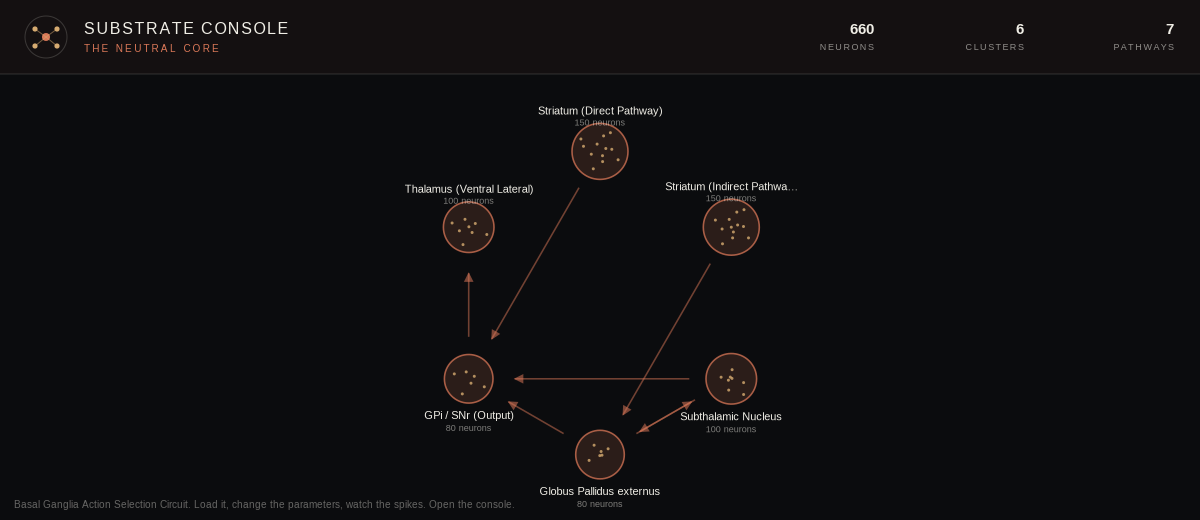
Readers exploring how spiking neuron parameters and local connectivity shape network activity can inspect the Leaky Integrate-and-Fire (LIF) dynamics directly on the Substrate Console and compare them with the broader substrate-independence framework on our Thermodynamic Computing hub.
Comparison to The Consciousness AI
The Consciousness AI’s Neutral Core explores spiking dynamics and recurrent binding, while our interactive Substrate Console runs Leaky Integrate-and-Fire (LIF) neurons in the browser. Neither the project’s GPU training architecture nor the browser console currently runs on physical memristive hardware or implements threshold-memristor STDP equations.
Both November 2026 papers are relevant to open design questions in our substrate-migration roadmap. If a future version of our architecture moves from digital tensors onto mixed-signal or memristive neuromorphic silicon (alongside platforms like SpiNNaker2 or BrainScaleS-2), learning rules will have to survive state-dependent conductance bounds and analog threshold drift. Testing whether verified stimulus representations survive those physical non-idealities is a concrete empirical check on substrate independence.
Open Engineering Hurdles
Both studies rely heavily on hardware-informed device modeling rather than large-scale multi-million-synapse fabricated memristor arrays. Scaling CMOS-memristor crossbars still faces write endurance limits, IR-drop across dense wordlines, and sneak-path currents. Even so, pairing device-informed STDP (arXiv:2611.00119) with hardware-aware information leakage analysis (arXiv:2610.39688) signals that neuromorphic engineering in late 2026 is moving past idealized software toys toward honest accounting of real analog matter.