


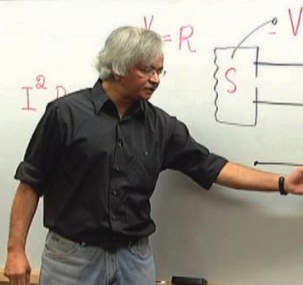
Supriyo Datta
Elmore Family School of Electrical and Computer Engineering, Purdue University
Builder The claim is about what the hardware does, and the philosophy is left open

Supriyo Datta is a device physicist at Purdue University whose work runs from electron transport in nanoscale conductors to spintronics. With Biswajit Das he proposed the spin field-effect transistor in 1990, and his textbooks on quantum transport set out how current flows through devices a few atoms wide.
In 2017 he co-authored, with Kerem Camsari, Rafatul Faria and Brian Sutton, the paper that introduced stochastic p-bits for invertible logic in Physical Review X. The 2019 review p-bits for probabilistic spin logic, with Camsari and Sutton, proposed the p-bit as a general unit between the deterministic bit and the qubit. It fluctuates between 0 and 1 at random, its inputs set the bias, and coupled p-bits sample from the Boltzmann distribution of an Ising model. The paper argued that a magnetic tunnel junction with a low energy barrier can supply that randomness from thermal noise at room temperature.
He is covered here under the Builder position, for the device concept. The thermodynamic chips now in development and the FPGA machines described in Kerem Camsari’s one million p-bit FPGA computer both build on the p-bit. No view on consciousness is attributed to him.
Known for. Quantum transport theory of nanoscale devices, the Datta-Das spin transistor proposal (1990), and co-authorship of the p-bit framework for probabilistic computing (2017, 2019)
Coverage on this site
Related researchers
- Kerem CamsariDepartment of Electrical and Computer Engineering, University of California, Santa BarbaraThe p-bit, a binary unit that fluctuates at random under the control of its inputs, and probabilistic computers built from p-bits on FPGAs, including a networked machine with one million p-bits (arXiv 2606.25313, 2026)
- Navid Anjum AaditDepartment of Electrical Engineering, Stanford University (present address); previously University of California, Santa BarbaraFirst author of the sparse Ising machine on FPGAs (Nature Electronics, 2022) and of the programmable probabilistic computer with one million p-bits (arXiv 2606.25313, 2026)
- Vikas AgnihotriIndependent Aerospace and Neuromorphic Systems ResearcherNeuromorphic Satellite Intelligence framework, radiation-induced energy overhead model for spiking neural hardware, constrained on-orbit STDP
- Matt AngleParadromicsFounder and CEO of Paradromics, developer of the Connexus Direct Data Interface high-data-rate brain-computer interface
- Isabella R. BeckettCoauthor of the MaleCNS preprint comparing male and female Drosophila brain connectomes
- Stuart BergFirst author of the MaleCNS preprint on the male Drosophila central nervous system
Supriyo Datta is listed with the other builders, who hold that the claim is about what the hardware does, and the philosophy is left open. The positions themselves are set out in the index of consciousness theories. Every researcher covered on this site is indexed in the directory of consciousness researchers.