


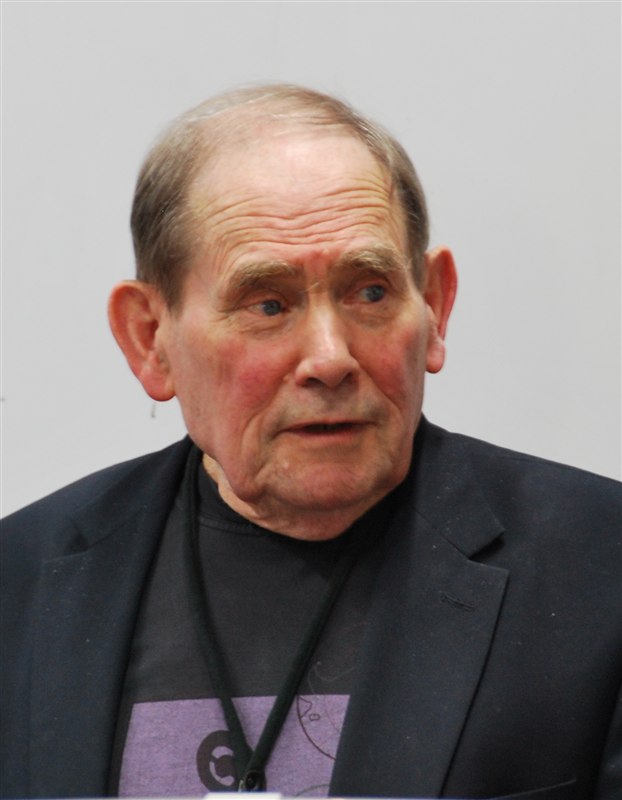
Sydney Brenner
MRC Laboratory of Molecular Biology, Cambridge
Builder The claim is about what the hardware does, and the philosophy is left open
_(cropped).jpg)
Sydney Brenner proposed research on Caenorhabditis elegans in 1963 and began its molecular and developmental biology program in 1974. The choice was deliberate. He wanted a multicellular organism small enough that its complete development and nervous system could be known, and simple enough that genetics could reach every cell.
The program produced three Nobel prizes in its first decades. Brenner shared the 2002 Nobel Prize in Physiology or Medicine with H. Robert Horvitz and John Sulston for discoveries on the genetic regulation of organ development and programmed cell death. Martin Chalfie’s green fluorescent protein work and Andrew Fire and Craig Mello’s RNA interference work on the worm earned further prizes, and a fourth followed for microRNA discovery in 2024. The nervous system result arrived in 1986, when John G. White, Eileen Southgate, J. N. Thomson and Brenner published the complete 302-neuron wiring diagram of the adult hermaphrodite in Philosophical Transactions of the Royal Society B.
This site’s Builder category refers to the worm program and the connectome dataset it produced. The dataset is the founding object of connectomics and the smallest complete test case for whole brain emulation, which makes it the place where claims about structure generating behavior are first checked. Brenner’s program did not take a position on consciousness, and the connectome describes wiring rather than experience.
Known for. Founding the C. elegans research program, the 1986 connectome, the 2002 Nobel Prize in Physiology or Medicine
Coverage on this site
Related researchers
- John G. WhiteMRC Laboratory of Molecular Biology, CambridgeFirst author of the 1986 complete C. elegans nervous system reconstruction
- Matt AngleParadromicsFounder and CEO of Paradromics, developer of the Connexus Direct Data Interface high-data-rate brain-computer interface
- Isabella R. BeckettCoauthor of the MaleCNS preprint comparing male and female Drosophila brain connectomes
- Stuart BergFirst author of the MaleCNS preprint on the male Drosophila central nervous system
- Edward BoydenMassachusetts Institute of Technology, Howard Hughes Medical InstituteExpansion microscopy, optogenetics, connectomics tools for consciousness research
- Kwanghun ChungMassachusetts Institute of TechnologyFirst author of CLARITY, hydrogel-tissue transformation for intact brain imaging
Sydney Brenner is listed with the other builders, who hold that the claim is about what the hardware does, and the philosophy is left open. The positions themselves are set out in the index of consciousness theories. Every researcher covered on this site is indexed in the directory of consciousness researchers.