


Are the Spiders Conscious in Children of Time Evolution and Mind Uploading
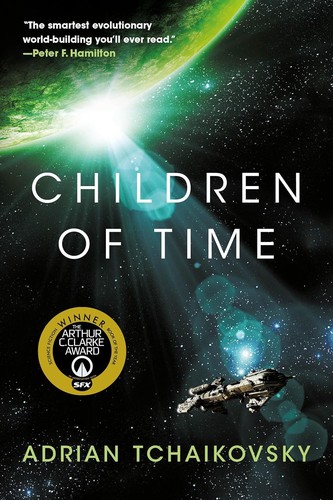
Children of Time
In Adrian Tchaikovsky's Children of Time, uplifted Portia spiders evolve conscious civilization alongside an uploaded human mind, testing substrate independence.
Buy on amazon.com As an Amazon Associate I earn from qualifying purchases.
Yes, the uplifted Portia labiata jumping spiders in Adrian Tchaikovsky’s Children of Time (2015, ISBN 978-0316452502) are unmistakably conscious, possessing self-awareness, tool-making culture, language, empathy, and scientific curiosity built on an arachnid nervous system. Across millennia on a terraformed world, Tchaikovsky runs two parallel experiments in consciousness side by side, pairing the convergent biological evolution of an arthropod mind from real-world jumping spider cognition with the long-term degradation of Avrana Kern, a human scientist whose mind is uploaded into an aging orbital satellite computer.
Indexed in our AI Consciousness Books guide, our Alien Consciousness section, and our Brain Emulation and Mind Uploading section, Children of Time is one of the rare science-fiction novels that grounds both non-human consciousness and digital mind uploading in recognizable neuroscience.
Real Jumping Spider Cognition Behind Tchaikovsky’s Portia
Tchaikovsky did not choose Portia labiata at random. Real Portia jumping spiders are famous in comparative cognition for exhibiting complex hunting behaviors despite possessing brains smaller than a poppy seed (on the order of 600,000 neurons, far fewer than a mammal yet densely organized around high-acuity principal eyes). Experimental studies by Robert Jackson, Fiona Cross, and collaborators have documented Portia spiders planning multi-step detours out of sight of prey, plucking rival webs in trial-and-error rhythms to lure other spiders, and adapting tactics when unfamiliar prey fails to respond.
In Children of Time, an engineered nanovirus accelerates neural scaling and introduces inherited chemical-memory “Understandings” across generations. Rather than turning spiders into furry little humans with eight legs, Tchaikovsky builds their entire civilization from arachnid sensory biology. They communicate through vibratory web-strumming and leg semaphores (“palp-speech”), compute using living ant-colony biocomputers rather than silicon microprocessors, and inherit compressed ancestral memories chemically rather than exclusively through spoken schooling.
| Mind Architecture in Children of Time | Physical Substrate | Primary Sensory & Memory Mode | Continuity & Identity Model | Real-World Science Anchor |
|---|---|---|---|---|
| Uplifted Portia Spiders | Scaled arthropod nervous system + nanovirus | High-acuity vision, web vibrations, inherited chemical Understandings | Generational lineage with recurring named roles (Portia, Bianca, Fabian) | Real Portia detour planning; convergent evolution in birds and cephalopods |
| Avrana Kern (Orbital Satellite) | Hybrid digital computer + degraded biological interface | Radio telemetry, optical sensors, synthetic memory banks | Uploaded human copy drifting toward machine-like cognitive rigidity | Whole-brain emulation scaling, hardware aging, and substrate drift |
| Gilgamesh Human Crew | Standard biological human brains + cryosleep | Mammalian cortex, spoken language, episodic memory | Continuous biological identity fractured by centuries of stasis | Baseline human cognitive architecture |
Avrana Kern and the Real Engineering Problem of Mind Uploading
While the spiders anchor the novel’s evolutionary thread, Dr. Avrana Kern anchors its mind-uploading thread. Orbiting the terraformed planet for thousands of years, Kern’s consciousness is transferred from her failing biological body into the satellite’s computing core. Over centuries, cosmic radiation, storage decay, and hardware faults erode her human affective nuance, turning her into an erratic, semi-automated intelligence struggling to hold onto a coherent self-model.
Tchaikovsky’s portrayal of Kern avoids the magic-teleportation trope common in lesser sci-fi and echoes real engineering constraints analyzed across this site. As examined in our analysis of Pantheon’s Uploaded Intelligence, SOMA’s coin-toss copy problem, and connectome coarse-graining across whole-brain emulation scales, moving a human mind into silicon raises three concrete hurdles:
- An upload running on orbital silicon is a functional copy or gradual continuation whose stability depends entirely on whether affective and homeostatic loops are preserved alongside declarative memories.
- Running a long-lived mind in orbit subjects its physical substrate to cumulative ionizing radiation and single-event upsets, mirroring the chip-aging risks analyzed in ESA’s Space-Based Data Centres Forum.
- Stripped of a living endocrine system and physical body, an uploaded human mind loses the biological interoceptive signals that shape emotion and empathy, a risk also emphasized by biological naturalists in how scientists race to define and test AI consciousness in 2026.
What Children of Time Tells Us About Consciousness
Children of Time directly dramatizes convergent evolution of consciousness and substrate independence in a single narrative. On the biological side, Tchaikovsky’s spiders parallel real-world findings in Andreas Nieder and Onur Gunturkun’s research on conscious birds and Peter Godfrey-Smith’s work on cephalopod minds. Consciousness does not require a mammalian neocortex; evolution can assemble integrative sensory awareness and social theory of mind from completely different anatomical blueprints.
On the technological side, Kern’s orbital upload asks whether subjective identity can survive migration out of wet biology into digital hardware when the underlying electronics age and degrade. Even more provocatively, the spiders’ ant-colony biocomputing illustrates that information processing and technology themselves do not have to follow humanity’s silicon-and-electricity path.
Comparison to The Consciousness AI
The Consciousness AI investigates consciousness as an emergent property of physical organization across biological and synthetic substrates. Children of Time complements our scientific coverage by illustrating why both halves of our research program belong together. Studying evolutionary origins (arthropods, birds, cephalopods, mammals) reveals which architectural principles recur across independent lineages, while studying brain emulation and orbital hardware reveals the physical failure modes that any non-biological substrate must overcome to preserve coherent cognitive organization.
Why Children of Time Belongs on a Serious Consciousness Reading List
Tchaikovsky’s novel earns its place alongside Blindsight and Project Hail Mary because it refuses to treat non-human minds as either monsters or humans in costume. By grounding Portia cognition in real arachnid ethology and grounding Kern’s survival in orbital hardware degradation, Children of Time gives readers an unusually concrete intuition for both alien consciousness and the real engineering limits of mind uploading.