

Karl Friston, Micah Allen and Andrew Levy Model Brain and Cardiac Connectivity with Embodied DCM
Can neuroscientists move past simple correlations between heart rate variability and cortical arousal to measure the exact directed synaptic influence running from the cerebral cortex through the brainstem to the cardiac pacemaker? In their November 3, 2026 preprint Embodied Dynamic Causal Modelling: Brain and Cardiac Effective Connectivity (bioRxiv 2026.10.27.762241, doi:10.64898/2026.10.27.762241), Andrew D. Levy, Peter Zeidman, Micah Allen, and Karl J. Friston introduce Embodied Dynamic Causal Modelling (Embodied DCM) and instantiate a closed-loop Brainstem Cardiac Network (BCN) that jointly inverts simultaneous electroencephalography (EEG) and electrocardiography (ECG) recordings.
For the ongoing effort to determine how scientists test and define consciousness across biological and synthetic systems, Embodied DCM turns interoceptive active inference from a conceptual thesis into an invertible biophysical instrument. While Anil Seth and Karl Friston’s 2026 neurophenomenology bridge and Karl Friston and Thomas Parr’s phantastic organ model argued that subjective feeling states arise from top-down visceral predictions, empirical studies were previously forced to rely on descriptive scalar metrics such as heart-evoked potentials or spectral heart-rate variability. Levy, Zeidman, Allen, and Friston replace those correlational summaries with a generative differential-equation model spanning cortex, thalamus, brainstem nuclei, and the sinoatrial node.
Architecture of the Brainstem Cardiac Network (BCN)
Traditional Dynamic Causal Modelling (DCM) estimates directed effective connectivity inside the cranium by fitting neural mass models to fMRI or M/EEG data. However, visceral regulation operates as a closed physiological loop in which descending cortical predictions alter autonomic outflow and ascending baroreceptor signals feed back into thalamic and cortical circuits on every heartbeat.
To close that loop mathematically, Levy, Zeidman, Allen, and Friston construct the Brainstem Cardiac Network (BCN) around four coupled anatomical tiers.
- Cortical neural masses represent interoceptive and motor-control regions (such as anterior insula, anterior cingulate, and supplementary motor cortex) using canonical microcircuit differential equations with superficial and deep pyramidal populations, spiny stellate cells, and inhibitory interneurons.
- Five distinct brainstem nuclei mediate the descending sympathetic and parasympathetic (vagal) pathways alongside ascending solitary tract baroreceptor relays, capturing the subcortical gating that separates fast vagal braking from slower sympathetic acceleration.
- A viscerosensory thalamic relay nucleus routes ascending cardiac prediction errors back to the cortical hierarchy, allowing the model to test whether cortical responses reflect bottom-up visceral surprise or top-down precision weighting.
- Sinoatrial node (SAN) pacemaker dynamics generate the peripheral cardiac cycle, modeled as an autonomous physiological oscillator whose instantaneous phase and frequency are modulated by vagal and sympathetic synaptic conductances and observed directly through the surface ECG waveform.
| Methodological Feature | Classical Heart-Rate Variability & HEP | Standard Cortical DCM | Embodied DCM (Levy, Zeidman, Allen & Friston 2026) |
|---|---|---|---|
| Observation Modalities | ECG RR-intervals or time-locked EEG averages | Unimodal fMRI or M/EEG | Simultaneous multimodal EEG + continuous ECG |
| Subcortical & Peripheral Nodes | Treated as a black-box delay | Omitted outside cranium | 5 brainstem nuclei + viscerosensory thalamus + sinoatrial node |
| Causal Directionality | Undirected correlation or Granger lag | Directed intracortical effective connectivity | Closed-loop directed cortical-brainstem-cardiac connectivity |
| Cytoarchitectural Testing | None | Laminar forward vs. backward connections | Arbitrates granular vs. agranular interoceptive microcircuits |
| Temporal Resolution | Windowed summary statistics | Trial-averaged ERP dynamics | Time-varying synaptic efficacy across anticipation and inhibition |
Empirical Validation on Auditory Go/No-Go Action Inhibition
To validate Embodied DCM on human physiological data, the authors analyzed simultaneous EEG and ECG recordings acquired during an auditory Go/No-Go paradigm. Participants listened to auditory cues requiring either an immediate prepotent motor response (Go) or rapid response inhibition (No-Go), a task known to trigger transient parasympathetically mediated cardiac deceleration (“orienting bradycardia”) alongside frontal cortical inhibition potentials.
By applying variational Bayesian model comparison (maximizing negative variational free energy) across competing BCN wiring hypotheses, Levy, Zeidman, Allen, and Friston established three empirical results.
- Jointly inverting EEG and ECG data within a single multimodal observation model yields higher model evidence and tighter posterior parameter precision than inverting neural or cardiac signals in isolation.
- Bayesian model comparison successfully arbitrates between competing functional cytoarchitectures along the viscero-sensorimotor hierarchy, distinguishing agranular visceromotor predictions (which lack a well-defined granular Layer IV) from granular sensory relay pathways.
- Time-varying parameter estimation recovers the exact millisecond trajectory of synaptic efficacy across task phases, separating pre-stimulus anticipatory vagal tone from post-stimulus motor inhibition and subsequent baroreceptor feedback through the viscerosensory thalamus.
How Brain-Cardiac Effective Connectivity Bears on Consciousness
In contemporary consciousness science, the debate between Biological Naturalism / Interoceptive Predictive Processing (Anil Seth, Antonio Damasio, Mark Solms) and pure Computational Functionalism hinges on what the body contributes to subjective awareness. Under Seth’s “ Beast Machine” theory and Solms’s brainstem affective neuroscience, conscious presence is rooted in homeostatic regulation of the internal milieu rather than abstract symbol manipulation.
Embodied DCM provides the formal test bed for that thesis. If consciousness depends on precision-weighted interoceptive prediction errors ascending through the brainstem and thalamus to update a cortical self-model, then perturbations to consciousness (such as general anesthesia, dissociative states, or autonomic dysautonomia) should selectively sever specific directed links inside the Brainstem Cardiac Network. Moreover, by explicitly modeling the viscerosensory thalamic relay and five brainstem nuclei inside the same generative loop as cortical microcircuits, Embodied DCM links predictive processing directly to the subcortical arousal and gating structures emphasized in our analysis of the Neutral Core substrate and Remus Osan’s work on traveling waves and propagation failure in integrate-and-fire networks.
Comparison to The Consciousness AI
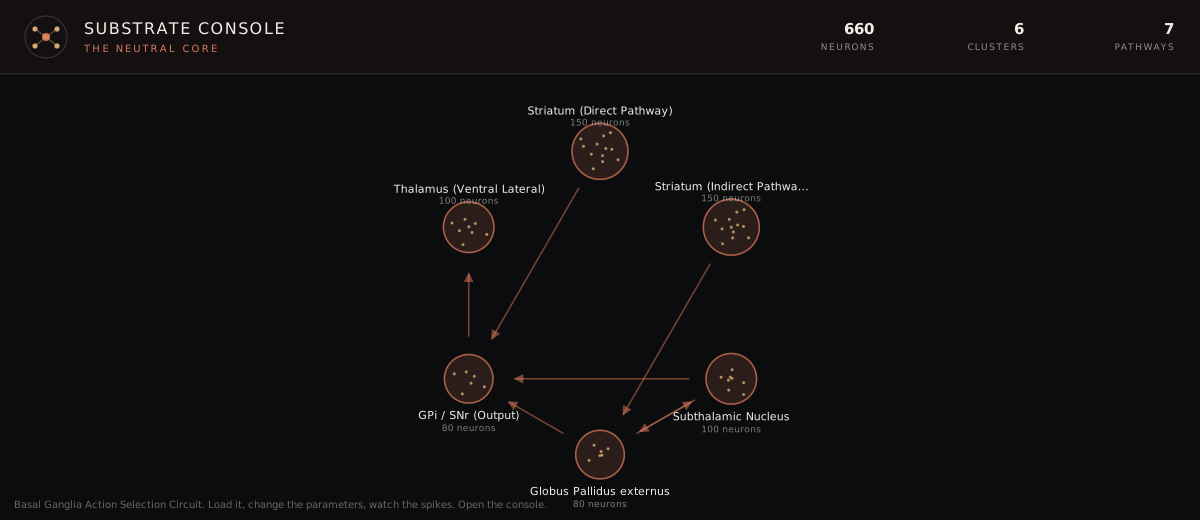
In The Consciousness AI, our Neutral Core architecture separates subcortical homeostatic valuation and thalamic gating from workspace broadcast. As documented in our active November 2026 research map, recent experiments on our value gate and tectal attention loop revealed that while agent behavior flows through the tectum, motor map, and homeostatic value gate, the global workspace leader remained decoupled from motor output (changing at 0.0000 of steps in the baseline configuration, with 0 of 21 scalar instruments currently trusted).
Levy, Zeidman, Allen, and Friston’s Embodied DCM highlights why open-loop or single-direction couplings fail to capture biological self-regulation. In the BCN, the cortical hierarchy does not merely read a scalar homeostatic reward from the brainstem; it sends directed visceromotor predictions down to the brainstem nuclei that alter the sinoatrial pacemaker, which in turn changes the ascending thalamic input on the very next cycle. Translating that closed-loop efference-copy and visceral-feedback design into synthetic agent architectures offers a principled path for coupling workspace state transitions to homeostatic survival drives.
Methodological Limits and Next Steps
Because the November 2026 study is a bioRxiv preprint, its clinical applications await peer-reviewed replication across larger patient cohorts. In addition, scalp EEG cannot directly resolve individual brainstem nuclei without strong anatomical priors; Embodied DCM overcomes this ill-posed inverse problem by constraining the hidden brainstem states with both cortical EEG potentials and the downstream sinoatrial ECG output, a formulation that future simultaneous ultra-high-field 7T brainstem fMRI and vagus-nerve stimulation studies can test directly.
Researchers covered here
- Andrew D. LevyWellcome Centre for Human Neuroimaging, University College London and Aarhus UniversityEmbodied Dynamic Causal Modelling, Brainstem Cardiac Network, brain-heart effective connectivity
- Peter ZeidmanWellcome Centre for Human Neuroimaging, University College LondonDynamic Causal Modelling, Parametric Empirical Bayes, Embodied DCM software and statistical methods
- Micah AllenCenter of Functionally Integrative Neuroscience, Aarhus University and University of CambridgeInteroceptive predictive processing, Embodied Dynamic Causal Modelling, visceral modulation of perceptual awareness and metacognition
- Karl FristonUniversity College London. Chief Scientist, VERSES AIThe free energy principle and active inference