


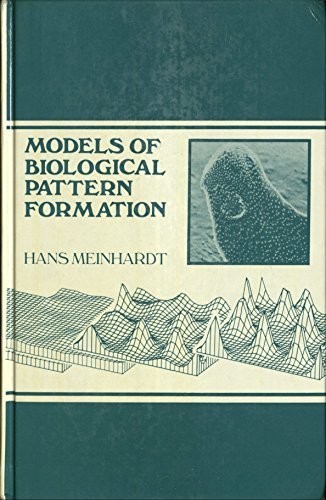
Hans Meinhardt Models of Biological Pattern Formation and Self-Organization
Models of Biological Pattern Formation
Hans Meinhardt's 1982 monograph Models of Biological Pattern Formation formalizes local activation and long-range inhibition, explaining how tissues self-organize and regenerate.
Buy on amazon.com As an Amazon Associate I earn from qualifying purchases.
How does a nearly uniform ball of embryonic cells break symmetry to build a head at one end, a tail at the other, and evenly spaced segments in between, and then restore those proportions if half the organism is cut away? In Models of Biological Pattern Formation (Academic Press, 1982, ISBN 0124886205), theoretical biologist Hans Meinhardt answered that question with a compact mathematical principle developed with Alfred Gierer. Local self-enhancement coupled with long-range inhibition can generate stable, self-regulating spatial patterns from tiny random fluctuations without any central blueprint.
Indexed in our Bioelectricity hub and AI Consciousness Books guide, Meinhardt’s 1982 monograph stands alongside D’Arcy Wentworth Thompson’s On Growth and Form and Michael J. Apter’s Cybernetics and Development as a mathematical pillar of self-organizing biology, connecting directly to the race to define AI consciousness.
Local Activation and Long-Range Inhibition
Alan Turing proved in 1952 that two diffusing chemicals can spontaneously form spatial waves, yet his linear equations did not easily explain biological regeneration or size invariance. In 1972, Alfred Gierer and Hans Meinhardt identified the exact nonlinear requirement for biological pattern formation. A slowly diffusing activator stimulates its own production locally while also triggering a rapidly diffusing inhibitor (or depleting a shared substrate) that suppresses activation farther away.
| Patterning Mechanism | Local Dynamics | Long-Range Coupling | Biological Phenomena Modeled |
|---|---|---|---|
| Activator-Inhibitor (Gierer-Meinhardt) | Autocatalytic local self-amplification | Fast-diffusing lateral inhibitor | Hydra head regeneration, spacing of bristles and leaf veins |
| Activator-Depleted Substrate | Local self-amplification consuming a precursor | Rapid replenishment from neighboring tissue | Periodic stripes, segmentation, branching networks |
| Bioelectric Gap-Junction Bistability (Modern) | Bistable ion-channel feedback on membrane voltage | Voltage-gated gap junctions sealing domain borders | Planarian head-tail polarity, persistent tissue pattern memory |
In Models of Biological Pattern Formation, Meinhardt walked through computer simulations showing how these coupled differential equations reproduce Hydra regeneration after transplantation, insect segment boundaries, vertebrate limb axes, and net-like vascular branching. When a simulated Hydra is bisected, the inhibitor concentration drops in the lower half, allowing a new activator peak to emerge spontaneously at the cut surface and regenerate a properly scaled head.
From Chemical Morphogens to Bioelectric Pattern Memory
Although Meinhardt framed his 1982 equations primarily around diffusing chemical morphogens, the mathematical structure is substrate-independent. Any living medium that combines local positive feedback with long-range lateral coupling obeys the same stability and bifurcation rules.
That is why Meinhardt’s monograph sits squarely inside Dr. Michael Levin’s bioelectricity bibliography. In developmental bioelectricity, resting membrane voltage (V_mem) provides a rapid physical medium for symmetry breaking and pattern storage. Positive feedback through voltage-sensitive ion channels creates bistable cellular states, while gap junctions couple neighboring cells across long tissue distances. When Levin’s laboratory alters planarian bioelectric prepatterns or builds cellular collectives described in our Bioelectricity hub, the resulting anatomical attractors behave like electrical realizations of Meinhardt’s self-regulating pattern generators, paired with persistent memory across cell generations.
What Models of Biological Pattern Formation Tells Us About Consciousness
Meinhardt’s book does not address subjective experience, yet it resolves a conceptual trap that frequently distorts debates about emerging consciousness. Critics often assume that coherent global organization requires either a single central controller or an explicit top-down program encoding every detail. Meinhardt proved mathematically that distributed local interactions with the right feedback topology maintain global proportions, detect damage, and converge back onto stable macroscopic attractors on their own.
For The Consciousness AI’s focus on consciousness as an emergent property, this mathematical lesson separates substrate from dynamical organization. Whether implemented in chemical reaction-diffusion, coupled somatic voltage networks, or recurrent neural architectures, self-sustaining global attractors arise from feedback geometry rather than from a magic substance. At the same time, strict facts discipline applies. A Gierer-Meinhardt attractor explains spatial self-organization and regeneration; it does not by itself constitute sentience or phenomenal consciousness.
Comparison to The Consciousness AI and bioelectrics
Meinhardt’s simulations relied on forward numerical integration of coupled partial differential equations, tuning parameters by hand to see which patterns emerged. Our open-source PyTorch library bioelectrics (pip install bioelectrics, MIT licence, Zenodo DOI 10.5281/zenodo.23531183) brings modern automatic differentiation to the electrical counterpart of that modeling tradition.
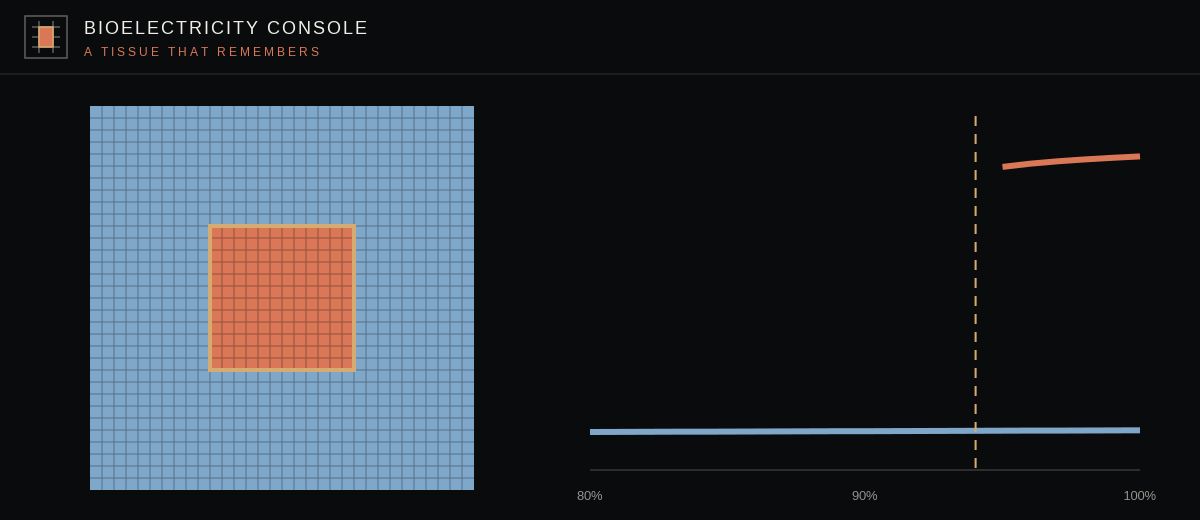
In bioelectrics, researchers simulate coupled somatic cells governed by ion channels, pumps, and voltage-gated gap junctions, and then differentiate directly through the dynamics to ask the inverse question. Given a desired spatial voltage pattern, which realizable channel modulation or gap-junction blocker moves the tissue into that attractor? Whereas Meinhardt’s 1982 book models chemical activator-inhibitor PDEs, bioelectrics specifically models ion-level bioelectric circuits in somatic tissue sheets. You can test bistable voltage domains interactively in our Bioelectricity Console or inspect the library below.

Strengths and Limits of Models of Biological Pattern Formation
Models of Biological Pattern Formation is unusually accessible for a mathematical biology monograph. Meinhardt paired clear equations with step-by-step graphical plots (and even included BASIC program listings in later editions) so biologists could test every model directly. Its primary limitation is that pure chemical reaction-diffusion models struggle to capture the speed of long-range electrical signaling and the mechanical forces acting inside real embryos. Today, developmental biology combines Meinhardt’s reaction-diffusion logic with mechanical cues and bioelectric voltage maps into hybrid multi-physics models. Explore our Bioelectricity apparel collection below to support open research.
Bioelectricity
Planaria, axolotls and the voltage patterns that tell cells what to build. Every order funds the research.
-
 Planaria - Bioelectricity T-Shirt
From $23.99
-
 Planaria - Bioelectricity T-shirt | Small Chest Logo
From $23.99
-
 Axolotl - Bioelectricity T-Shirt
From $24.99
-
 Axolotl - Bioelectricity T-shirt | Small Chest Logo
From $23.99
-
 Cognition - Bioelectricity T-Shirt
From $23.99
-
 Cognition Bioelectricity T-shirt | Small Chest Logo
From $23.99