



Richard B. Borgens and Kenneth R. Robinson Electric Fields in Vertebrate Repair
Electric Fields in Vertebrate Repair
Richard B. Borgens, Kenneth R. Robinson, Joseph W. Vanable Jr., and Michael E. McGinnis document endogenous stump currents, limb regeneration, and spinal cord axon repair.
Buy on amazon.com As an Amazon Associate I earn from qualifying purchases.
When an adult newt loses a forelimb, its remaining stump drives a steady, measurable electrical current out of the wound surface for days before a new limb bud ever appears. When an adult frog suffers the same amputation, that current is weak or absent, and the wound heals as a scarred stump. In Electric Fields in Vertebrate Repair (Alan R. Liss, 1989, ISBN 0845142747), Richard B. Borgens, Kenneth R. Robinson, Joseph W. Vanable Jr., and Michael E. McGinnis assembled the first complete experimental synthesis of how endogenous ionic currents and weak applied direct-current fields govern regeneration across vertebrate limbs, skin wounds, bone, and the mammalian spinal cord.
Indexed in our Bioelectricity hub and AI Consciousness Books guide, Electric Fields in Vertebrate Repair is the experimental centerpiece that turned the forgotten century of bioelectricity into quantitative vertebrate physiology, connecting directly to the race to define AI consciousness.
Endogenous Stump Currents and Vertebrate Regeneration
Earlier researchers such as E. J. Lund and Robert O. Becker and Andrew A. Marino measured surface voltages across injured limbs, yet skeptics questioned whether those readings were mere electrode artifacts. Borgens, Vanable, and Lionel F. Jaffe settled that objection using the non-invasive vibrating probe developed with Richard Nuccitelli. They showed that amphibian skin acts as an active sodium-transporting battery. Immediately after amputation, currents of 10 to 100 microamperes per square centimeter exit the stump, powered by sodium influx across intact skin distant from the wound.
| Experimental System | Endogenous Electrical Signal | Causal Intervention Tested | Anatomical Outcome |
|---|---|---|---|
| Adult newt forelimb stump | Large outward sodium-driven current (10-100 uA/cm^2) | Blocked sodium uptake with amiloride or skin grafts | Limb regeneration failed or stalled |
| Adult Xenopus frog forelimb | Weak, brief stump current compared to newts | Applied weak cathodal DC field across the stump | Induced partial multi-tissue limb outgrowth with cartilage and nerve bundles |
| Embryonic axolotl neural tube | Transneural tube potential across developing wall | Shunted or reversed endogenous voltage gradient | Produced severe neural and craniofacial malformations |
| Guinea pig spinal cord lesion | Injury current collapsing across severed white matter | Applied weak steady or oscillating DC field | Guided regenerating axons across the lesion and improved behavioral reflexes |
Two results in the book stand out for their causal clarity. First, blocking the natural stump current in a regenerating newt prevents normal limb regrowth, showing that the electrical flow is an upstream requirement rather than an idle byproduct of tissue damage. Second, reversing the logic in mammals, Borgens showed that weak applied direct-current fields orient and accelerate axon regrowth across crushed guinea pig spinal cords, work that eventually moved oscillating-field stimulators into veterinary and human spinal injury trials.
How Single Cells Read Macroscopic Tissue Voltages
Kenneth R. Robinson’s chapters in the volume answer the mechanistic question of how an individual cell detects a voltage gradient of just a few millivolts per millimeter. Through studies of embryonic neurons, fibroblasts, and myoblasts, Robinson documented galvanotropism (oriented neurite growth toward the cathode) and galvanotaxis (directional cell migration).
Weak extracellular fields redistribute charged membrane receptors along the fluid lipid bilayer through lateral electrophoresis, concentrating growth-factor receptors and ion channels on one side of the cell. Asymmetric calcium influx then biases cytoskeletal polymerization, turning a tissue-scale electrical gradient into coordinated cellular steering. Together with Hans Meinhardt’s mathematical models of pattern formation, this cellular transduction layer explains how macroscopic anatomical order emerges from local physical interactions.
What Electric Fields in Vertebrate Repair Tells Us About Consciousness
At first glance, amphibian limb stumps and spinal cord lesions appear far removed from consciousness research. Yet the book demonstrates a physical principle that directly tests substrate independence. Non-neural epithelial sheets and migrating somatic cells maintain persistent, spatially structured voltage fields that encode anatomical targets and coordinate collective repair across thousands of cells.
In our project’s study of consciousness as an emergent property, this experimental record strengthens the case that goal-directed information processing in living systems did not begin with brains. Modern work in Michael Levin’s laboratory on planarian bioelectric memory and xenobots and the mapping of consciousness theories onto unconventional embodiments extends Borgens and Robinson’s findings from wound repair to whole-body morphogenetic memory. Strict facts discipline still applies. Demonstrating that vertebrate tissue uses steady electric fields to rebuild limbs and guide axons establishes non-neural control architecture; it does not claim that a healing stump has subjective experience.
Comparison to The Consciousness AI and bioelectrics
Borgens, Robinson, Vanable, and McGinnis asked both forward and inverse questions about living tissue. In the forward direction, how do ion pumps and epithelial conductances generate a stump current? In the inverse direction, what applied voltage or channel perturbation restores regeneration when the endogenous signal fails?
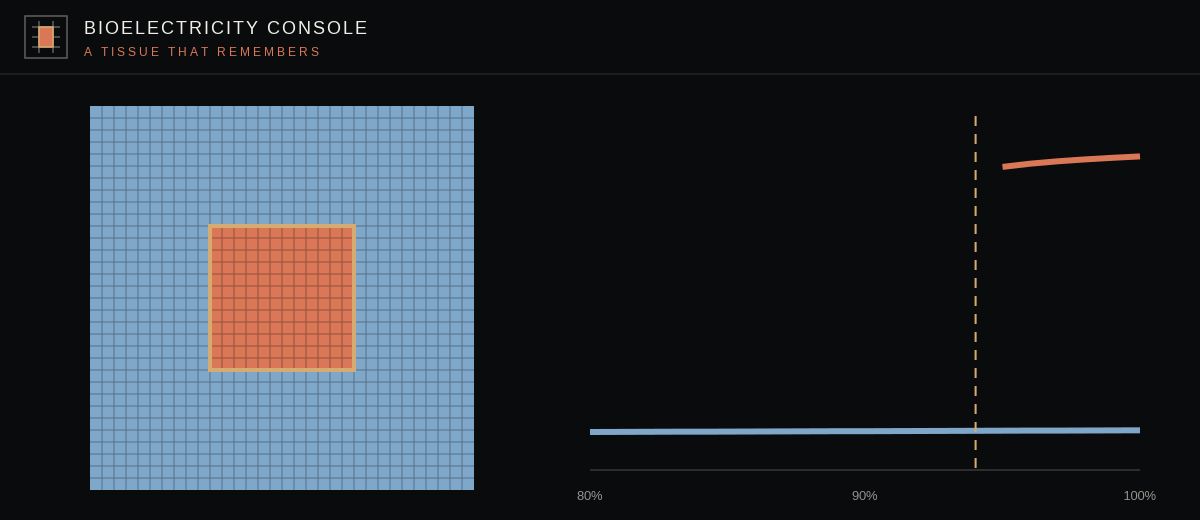
Our open-source PyTorch library bioelectrics (pip install bioelectrics, MIT licence, Zenodo DOI 10.5281/zenodo.23531183) implements that exact inverse-design workflow in software for somatic tissue sheets. Because every ion-channel conductance, pump flux, and gap-junction coupling carries a gradient, bioelectrics can search for realizable channel or blocker interventions that steer a simulated tissue toward a target resting voltage pattern. Its scope stays tightly bounded to coupled somatic cell sheets and ion-level electrodiffusion, rather than full three-dimensional vertebrate limb mechanics or clinical spinal-cord hardware. You can explore bistable voltage domains directly in our Bioelectricity Console or inspect the library below.

Strengths and Limits of Electric Fields in Vertebrate Repair
Electric Fields in Vertebrate Repair remains one of the clearest experimental monographs in bioelectricity because every major chapter pairs physical measurements with perturbation controls. Its main limitation reflects its 1989 publication date. The authors could measure total sodium current and apply external electrodes, yet they did not have modern genetic knockouts, optogenetic channels, or fluorescent voltage reporters to identify individual channel genes inside the blastema. Today those molecular tools have confirmed the book’s core experimental insight that electrical polarity is a causal control variable in vertebrate repair. Browse our Bioelectricity apparel collection below to support open research.
Bioelectricity
Planaria, axolotls and the voltage patterns that tell cells what to build. Every order funds the research.
-
 Planaria - Bioelectricity T-Shirt
From $23.99
-
 Planaria - Bioelectricity T-shirt | Small Chest Logo
From $23.99
-
 Axolotl - Bioelectricity T-Shirt
From $24.99
-
 Axolotl - Bioelectricity T-shirt | Small Chest Logo
From $23.99
-
 Cognition - Bioelectricity T-Shirt
From $23.99
-
 Cognition Bioelectricity T-shirt | Small Chest Logo
From $23.99
Researchers covered here
- Richard B. BorgensPurdue University, Center for Paralysis ResearchEndogenous stump currents in vertebrate limb regeneration and applied electric fields for spinal cord repair
- Kenneth R. RobinsonPurdue UniversityGalvanotropism, endogenous developmental electric fields, and cellular responses to weak physiological voltages