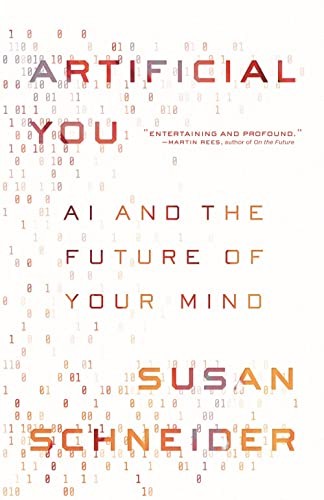
Susan Schneider's Artificial You and the Test for Machine Minds
Artificial You
Schneider's 2019 Princeton book argues mind designers work with tools they do not understand, and begins designing tests for machine consciousness.
Susan Schneider published Artificial You: AI and the Future of Your Mind with Princeton University Press on October 1, 2019, 192 pages, ISBN 9780691180144. The book is short and it is built like a warning label. Schneider, at publication the NASA/Baruch Blumberg Chair at the Library of Congress and director of the AI, Mind and Society Group at the University of Connecticut, addresses the moment when AI turns inward and reshapes the brain while also reaching outward toward machine minds. Her thesis is that we will be doing this with tools we do not understand how to use, the self, the mind and consciousness, and that an insufficient grasp of them could undermine the technology and bring suffering to conscious beings.
| Question the book asks | Where it lands |
|---|---|
| Can robots be conscious? | Open, but testable in principle |
| Can we merge with AI, as Musk and Kurzweil suggest? | The merge changes the subject before it settles the question |
| Is the mind just a program? | The claim carries the burden, and the evidence is not there |
| How would we know a machine is conscious? | By tests, which the book begins to design |
The book’s method, from skepticism to instrumentation
The book’s structure runs from diagnosis to instrument. The diagnostic half argues that our concepts of self and mind were built by evolution for biological brains, and that applying them to radically different systems invites systematic error. This is the alien minds framing the site’s later coverage developed from the book, examined in the CS26 verification problem analysis. The instrumental half responds to the diagnosis. Rather than declaring the question unanswerable, Schneider proposes ways to test for machine consciousness, work that grew into the Artificial Consciousness Test she developed afterward.
The book is careful about its own stance. It does not claim AI consciousness is impossible. It claims the evidential situation is worse than the public debate admits, and that policy should be calibrated to that uncertainty. David Chalmers’ cover description calls it a book of useful tools for thinking about the mind and its future, which is accurate. The tools are questions sharp enough to survive contact with an answer.
What the book changed in the debate
Two moves in the book reorganized the field’s discussion. First, it moved the consciousness question for AI from metaphysics to measurement, insisting that any claim about machine minds faces a verification burden. Second, it treated mind design, enhancement, uploading and merger, as decisions made before the science is settled, which converts philosophy of mind into a pre-deployment discipline. Both moves run directly against the optimism of Kurzweil’s 2045 forecast and the identity confidence of Rothblatt’s mindclone thesis, and both moves anticipate the verification-centered literature of the mid-2020s.
Comparison to The Consciousness AI
The book’s caution is the strongest statement of the evidential standard this site applies to itself. This project treats consciousness as an emergent property of organized physical activity, substrate independent in principle, and it therefore carries Schneider’s burden in full. A claim that a system has experience requires evidence, and the project’s research code, maintained in the tlcdv/the_consciousness_ai repository, publishes its architecture so that its claims are checkable rather than asserted. The book’s warning about mind design without understanding is the site’s founding reason to keep the theory, the code and the measurement claims separate.
What the 2019 Book Left Open
The book opened the instrumentation program and left its execution to the field. Whether any proposed test can distinguish genuine experience from sophisticated self-report remains the open problem the CS26 literature sharpened. The book’s own answer, humility plus convergent evidence, is the position the site’s verification coverage tracks. The field’s state of play is reviewed in the flagship overview of AI consciousness research, and the emulation-side consequences are collected on the brain emulation page.