


Costas Anastassiou
Allen Institute
Integrated information Consciousness is intrinsic causal power, measured as integrated information
Costas Anastassiou is a neuroscientist whose 2011 Nature Neuroscience paper with Rodolfo Perin, Henry Markram, and Christof Koch changed the status of the brain’s electric fields from byproduct to participant. The experiment showed that endogenous field fluctuations, at amplitudes the cortex itself produces, reliably entrain the firing of individual neurons. Ephaptic coupling, coupling through the extracellular field, became a measured property of cortical tissue rather than a theoretical curiosity. The work is examined on this site in the ephaptic coupling analysis, and the 2012 Buzsáki, Anastassiou, and Koch review in Nature Reviews Neuroscience remains the canonical account of where extracellular fields come from.
The program’s 2024 Neuron study refined the result in an important direction. Field entrainment differs by cell class, meaning a shared extracellular field is read with different sensitivity by different neuronal types. A field with structure is a channel with information-bearing capacity, which is exactly the property electromagnetic field theories of consciousness need and which this site treats as measured physics distinct from the theories built on it.
Anastassiou’s contribution to the consciousness debate is therefore foundational rather than ideological. Every field theory, from McFadden’s CEMI account to Susan Pockett’s, depends on fields being causally potent in the brain. The ephaptic literature supplies that dependency’s empirical grounding, and it simultaneously marks the line the theories must not cross without further evidence, since measured coupling does not by itself establish that field information is felt.
The 2026 Neuron traveling waves review takes the opposing position on wave generation, matching wave speeds to unmyelinated axon conduction and arguing that endogenous fields are too weak and too coarse to organize the phase-locked behavioral effects measured in behaving animals (Lyle Muller’s profile). This site keeps the dispute open, with both sides’ measurements presented in the ephaptic coupling analysis and in the review it answers.
Known for. Ephaptic coupling of cortical neurons, endogenous electric fields as causal participants in neural activity, extracellular field biophysics
Coverage on this site
Related researchers
-
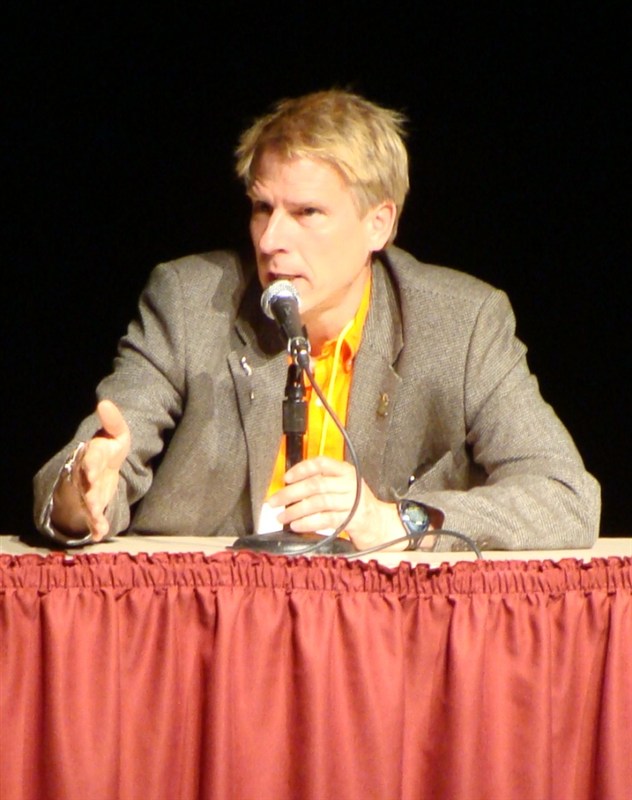 Christof KochAllen Institute for Brain Science and the Tiny Blue Dot FoundationNeural correlates of consciousness and co-development of Integrated Information Theory
- Larissa AlbantakisUniversity of Wisconsin-Madison, Center for Sleep and ConsciousnessIntegrated Information Theory 4.0 and dissociating intelligence from consciousness in artificial systems
- Anton ArkhipovAllen Institute for Brain ScienceLarge-scale neural simulation, biophysically detailed cortical models, AIBRAIN program, State of Brain Emulation Report 2025
- Nihat AyHamburg University of Technology; external professor, Santa Fe Institute; honorary professor, Leipzig UniversityInformation geometry and information-theoretic measures of complexity and causal integration
- Bernard J. BaarsThe Neurosciences InstituteGlobal Workspace Theory (GWT), cognitive architecture of conscious access, A Cognitive Theory of Consciousness (1988), In the Theater of Consciousness (1997)
- Adam B. BarrettSussex Centre for Consciousness Science, University of SussexContinuous field formulations of Integrated Information Theory, Measure-theoretic Phi, practical complexity measures, Granger causality
Costas Anastassiou is listed with the other integrated information theorists, who hold that consciousness is intrinsic causal power, measured as integrated information. The theory family behind that position is set out in the index of consciousness theories. Every researcher covered on this site is indexed in the directory of consciousness researchers.