


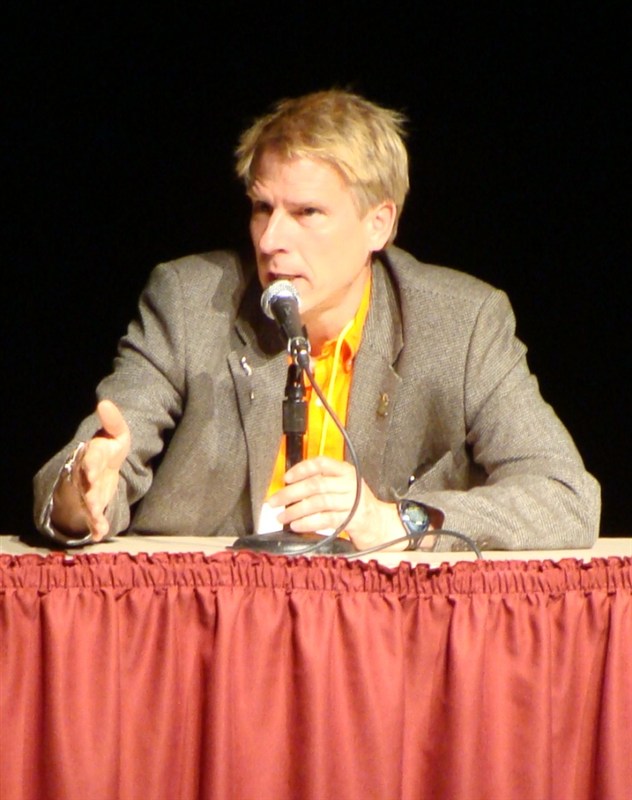
Christof Koch
Allen Institute for Brain Science and the Tiny Blue Dot Foundation
Integrated information Consciousness is intrinsic causal power, measured as integrated information

Christof Koch built his career on the premise that consciousness has neural correlates worth finding, first with Francis Crick, then as a long-time collaborator of Giulio Tononi on Integrated Information Theory. IIT treats experience as intrinsic causal power, measured as phi, which is why the theory rules out most current AI architectures regardless of their behavior. Koch has repeatedly said that a feedforward network could pass every behavioral test for consciousness and still have close to zero phi, since IIT cares about what a system is, not what it does.
At the 2026 “Behind and Beyond the Brain” symposium in Porto, Koch pushed that same causal-structure framework toward a more unsettling question. Consciousness science has mapped enormous amounts of neural correlation without explaining why any physical process should be accompanied by experience at all, the hard problem in its original form. Koch argued this gap justifies taking idealism and panpsychism seriously as live hypotheses rather than dismissing them, framing the brain as something that filters or shapes a more fundamental field of experience instead of manufacturing it from scratch.
The move is significant for AI consciousness research because it does not abandon IIT’s mathematics, it reinterprets what the mathematics is describing. If phi measures how much a system filters or individuates a pre-existing field rather than how much experience it manufactures, the criteria for evaluating artificial systems shift from “does this system generate consciousness” to “does this system’s causal structure carve out a distinct experiential perspective.” Koch has not resolved which reading is correct, and his own position remains that the empirical programme, measuring phi in biological and artificial substrates alike, should continue regardless of which metaphysics eventually turns out to be true.
His lab’s slice work on ephaptic coupling with Costas Anastassiou (his profile) is one of the measurements the 2026 Neuron traveling waves review argues against, where the review matches wave speeds to unmyelinated axon conduction and argues the in vitro field effects are too weak and coarse to organize the behavioral effects the recordings show (Lyle Muller’s profile carries that side). This site presents that dispute as open in the ephaptic coupling analysis.
Known for. Neural correlates of consciousness and co-development of Integrated Information Theory
Coverage on this site
- Ephaptic Coupling Shows the Brain's Electric Fields Shape Their Own Neurons September 2026
- Christof Koch and the Brain as Filter Argument Against AI Consciousness August 2026
Related researchers
- Costas AnastassiouAllen InstituteEphaptic coupling of cortical neurons, endogenous electric fields as causal participants in neural activity, extracellular field biophysics
- Larissa AlbantakisUniversity of Wisconsin-Madison, Center for Sleep and ConsciousnessIntegrated Information Theory 4.0 and dissociating intelligence from consciousness in artificial systems
- Anton ArkhipovAllen Institute for Brain ScienceLarge-scale neural simulation, biophysically detailed cortical models, AIBRAIN program, State of Brain Emulation Report 2025
- Nihat AyHamburg University of Technology; external professor, Santa Fe Institute; honorary professor, Leipzig UniversityInformation geometry and information-theoretic measures of complexity and causal integration
- Bernard J. BaarsThe Neurosciences InstituteGlobal Workspace Theory (GWT), cognitive architecture of conscious access, A Cognitive Theory of Consciousness (1988), In the Theater of Consciousness (1997)
- Adam B. BarrettSussex Centre for Consciousness Science, University of SussexContinuous field formulations of Integrated Information Theory, Measure-theoretic Phi, practical complexity measures, Granger causality
Christof Koch is listed with the other integrated information theorists, who hold that consciousness is intrinsic causal power, measured as integrated information. The theory family behind that position is set out in the index of consciousness theories. Every researcher covered on this site is indexed in the directory of consciousness researchers.