


Mike Davies
Intel Labs
Builder The claim is about what the hardware does, and the philosophy is left open
Mike Davies argues that the computational principles of biological intelligence, including sparse, asynchronous, event-driven processing and local synaptic learning rules, can be implemented in silicon, and that doing so is both practically useful and theoretically instructive. He has not published a position on whether consciousness is substrate independent, and none is assigned to him here. He does not claim that Loihi 2 is a conscious system. His position is that neuromorphic hardware faithfully implements the algorithmic level of neural computation, and that the efficiency gains over rate-coded networks are evidence that the algorithmic level is where the interesting features of intelligence reside.
That position carries a specific implication for consciousness research. If the temporal pattern of spiking activity is decisive for consciousness rather than the biological substrate that generates it, then a chip that can reproduce those patterns, including the diverse firing modes that LIF neurons cannot express, is a genuine experimental tool for consciousness science. Loihi 2’s programmable neuron microcode, which allows researchers to run Izhikevich or Resonate-and-Fire dynamics alongside LIF dynamics on the same hardware, is the feature that makes this argument empirically testable rather than merely theoretical.
The challenge Davies’s work has not resolved is the one Gualtiero Piccinini raises from the biological naturalist side, that producing the right temporal signatures in silicon may not be sufficient if consciousness depends on the specific physical processes of biological neurons. Davies’s research program does not take a position on that question, and the Loihi 2 architecture paper (Orchard, Frady, Davies et al., arXiv:2304.01210) is explicit that the chip is a research tool for studying neural computation rather than a system designed to satisfy consciousness criteria. That honesty about scope is the reason his work is useful as a reference point for substrate independence debates rather than a resolution of them.
Known for. Directing Intel's Neuromorphic Computing Lab and co-developing the Loihi and Loihi 2 neuromorphic research processors
Coverage on this site
Related researchers
- Matt AngleParadromicsFounder and CEO of Paradromics, developer of the Connexus Direct Data Interface high-data-rate brain-computer interface
- Isabella R. BeckettCoauthor of the MaleCNS preprint comparing male and female Drosophila brain connectomes
- Stuart BergFirst author of the MaleCNS preprint on the male Drosophila central nervous system
- Edward BoydenMassachusetts Institute of Technology, Howard Hughes Medical InstituteExpansion microscopy, optogenetics, connectomics tools for consciousness research
-
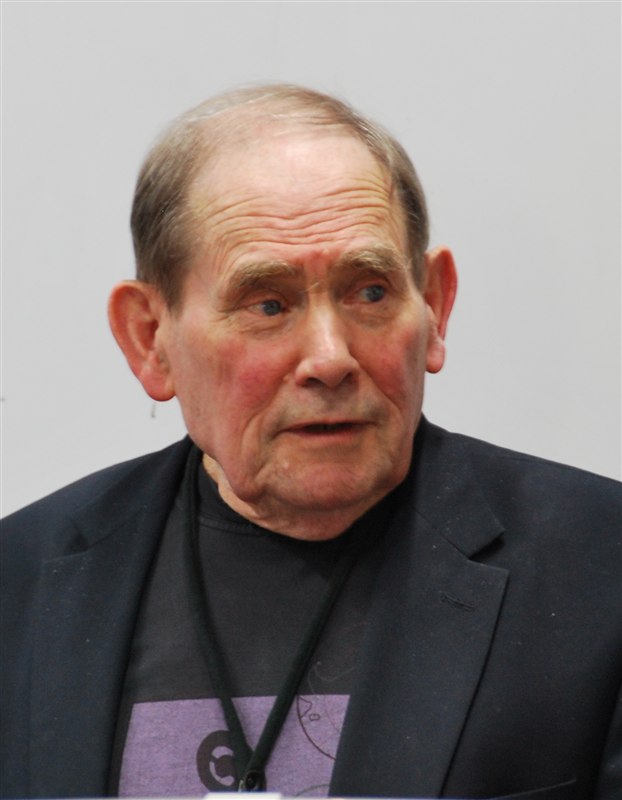 Sydney BrennerMRC Laboratory of Molecular Biology, CambridgeFounding the C. elegans research program, the 1986 connectome, the 2002 Nobel Prize in Physiology or Medicine
- Kwanghun ChungMassachusetts Institute of TechnologyFirst author of CLARITY, hydrogel-tissue transformation for intact brain imaging
Mike Davies is listed with the other builders, who hold that the claim is about what the hardware does, and the philosophy is left open. The positions themselves are set out in the index of consciousness theories. Every researcher covered on this site is indexed in the directory of consciousness researchers.