


Suresh Kumar TP
Independent Aerospace and Neuromorphic Systems Researcher
Builder The claim is about what the hardware does, and the philosophy is left open
Suresh Kumar TP is an aerospace and neuromorphic computing researcher who co-authored the October 2026 study “Neuromorphic Satellite Intelligence: A Comprehensive Architectural, Algorithmic, and System-Level Framework” (arXiv:2610.12471) with Vikas Agnihotri. The paper addresses the power, thermal, and radiation bottlenecks of orbital compute by deriving closed-form energy models for spiking neural networks calibrated against published Intel Loihi and SpiNNaker silicon measurements.
In addition to classifying four radiation-aware neuromorphic architecture classes (Rad-Neu, NeuHybrid, DEC Nodes, and NeuroSoC), Suresh Kumar TP and Agnihotri designed three satellite-specific spiking algorithms, the Spiking Kalman-Complementary Filter (SKCF) for spacecraft attitude estimation, the Temporal Contrast Anomaly Detector (TCAD) for telemetry health monitoring, and Spike-Based Adaptive Modulation and Coding (SAMC) for cognitive satellite links, paired with a constrained on-orbit STDP learning rule with bounded weight drift under single-event upsets.
His profile is Builder, included for establishing quantitative energy-accuracy-latency trade-off surfaces (8x to 47x energy reduction over GPU baselines within 2.1% accuracy) across CubeSat, geostationary, and deep-space mission envelopes.
Known for. Neuromorphic Satellite Intelligence framework, Spiking Kalman-Complementary Filter (SKCF), Temporal Contrast Anomaly Detector (TCAD), Spike-Based Adaptive Modulation and Coding (SAMC)
Coverage on this site
Related researchers
- Vikas AgnihotriIndependent Aerospace and Neuromorphic Systems ResearcherNeuromorphic Satellite Intelligence framework, radiation-induced energy overhead model for spiking neural hardware, constrained on-orbit STDP
- Matt AngleParadromicsFounder and CEO of Paradromics, developer of the Connexus Direct Data Interface high-data-rate brain-computer interface
- Isabella R. BeckettCoauthor of the MaleCNS preprint comparing male and female Drosophila brain connectomes
- Stuart BergFirst author of the MaleCNS preprint on the male Drosophila central nervous system
- Edward BoydenMassachusetts Institute of Technology, Howard Hughes Medical InstituteExpansion microscopy, optogenetics, connectomics tools for consciousness research
-
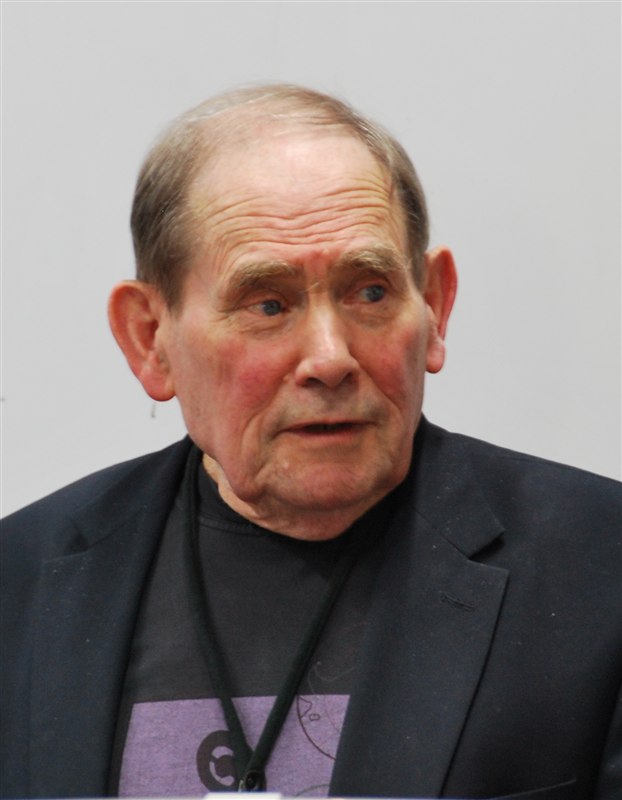 Sydney BrennerMRC Laboratory of Molecular Biology, CambridgeFounding the C. elegans research program, the 1986 connectome, the 2002 Nobel Prize in Physiology or Medicine
Suresh Kumar TP is listed with the other builders, who hold that the claim is about what the hardware does, and the philosophy is left open. The positions themselves are set out in the index of consciousness theories. Every researcher covered on this site is indexed in the directory of consciousness researchers.