

Three Decades of Consciousness Research Mapped Across 24,934 Neuroscience Records
When the modern neuroscientific study of consciousness accelerated in the late 1990s around the search for the neural correlates of consciousness (NCC), did the field grow into a unified science or split into disconnected research islands? On November 3, 2026, Qiangfan Meng, Haiqing Yu, Jianghong He, Haibo Di, Steven Laureys, Yongzhi Huang, Minpeng Xu, and Dong Ming published a large-scale quantitative audit in Reviews in the Neurosciences (doi:10.1515/revneuro-2026-0217), mapping three decades of consciousness research in neuroscience through a scientometric synthesis of intellectual evolution and emerging frontiers.
Starting from an initial retrieval of 24,934 Web of Science records and filtering to 22,836 peer-reviewed neuroscience publications and 639,975 cited references spanning 1998 to 2025, the authors apply CiteSpace, VOSviewer, and Bibliometrix network analysis to reconstruct the intellectual topology of the discipline. For readers tracking how scientists race to define and measure consciousness in 2026 and our 2026 scientific consensus report, Meng, Laureys, Ming, and colleagues replace informal narrative histories with hard citation-graph metrics.
The Three Primary Trajectories Across 639,975 Cited References
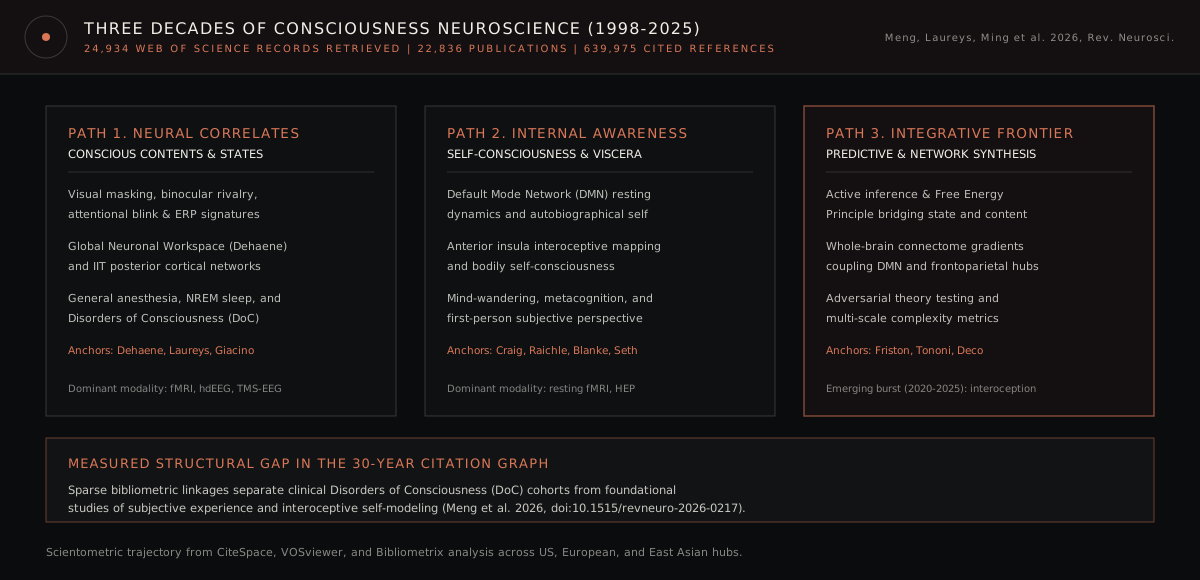
By computing document co-citation clusters, keyword burst timelines, and main-path citation trajectories across the 1998–2025 corpus, Meng, Laureys, Ming, and co-authors demonstrate that consciousness neuroscience organized itself along three distinct structural paths.
- Path 1 (Neural Correlates of Conscious Contents and States) forms the largest historical backbone of the corpus. Initiated by late-1990s visual masking and binocular rivalry paradigms (Francis Crick and Christof Koch), this path bifurcated into content-specific frontoparietal versus posterior cortical debates, anchored in co-citation networks by Stanislas Dehaene (Global Neuronal Workspace Theory) and Giulio Tononi (Integrated Information Theory), alongside global state transitions across general anesthesia, non-REM sleep, and clinical Disorders of Consciousness (DoC) anchored by Steven Laureys and Joseph T. Giacino.
- Path 2 (Internal Awareness, Self-Consciousness, and Interoception) emerged as a counter-movement to purely exteroceptive visual paradigms. Anchored in co-citation maps by Marcus Raichle’s characterization of the Default Mode Network (DMN), A. D. (Bud) Craig’s neuroanatomical mapping of lamina I spinothalamocortical interoceptive pathways to the anterior insula, Olaf Blanke’s bodily self-consciousness experiments, and Anil Seth’s interoceptive predictive coding, this trajectory studies resting-state self-referential thought, heart-evoked potentials, and first-person bodily perspective.
- Path 3 (Integrative Network and Predictive Frameworks) represents the newest convergence zone. Anchored heavily by Karl Friston’s Free Energy Principle and active inference, alongside whole-brain connectome harmonic and dynamical modeling (Gustavo Deco and Morten Kringelbach), this trajectory attempts to unify state and content by modeling how subcortical arousal and visceral precision modulate large-scale cortical communication gradients.
| Scientometric Dimension | Quantitative Finding in Meng, Laureys, Ming et al. (2026) | Structural Implication for the Field |
|---|---|---|
| Corpus Scale (1998–2025) | 24,934 retrieved WoS records; 22,836 analyzed papers; 639,975 cited references | Exponential growth from niche 1998 NCC studies to a major neuroscience discipline |
| Geographic Tri-Pole | Concentrated across the United States, Europe, and East Asia | Institutional hubs in Liège/Paris/London, US coastal universities, and Chinese neuroengineering centers |
| Top Co-Cited Anchors | Stanislas Dehaene, Karl Friston, Steven Laureys, Joseph T. Giacino, A. D. Craig | Divides citation authority across GNW, Active Inference, Clinical DoC, and Interoception |
| Recent Keyword Bursts | Subjective experience, disorders of consciousness, interoception, neural mechanisms | Shift away from isolated visual masking toward visceral self-modeling and bedside prognosis |
| Measured Structural Gap | Sparse bibliometric linkage between clinical DoC clusters and interoception/subjective experience | Bedside coma/MCS diagnostics and foundational selfhood theories rarely cite or test each other’s models |
The Measured Citation Gap Between Bedside Coma Science and Interoceptive Selfhood
The most actionable finding in the Reviews in the Neurosciences synthesis is not where publications cluster, but where citation bridges are missing. Meng, Laureys, Ming, and colleagues show that despite three decades of parallel growth, bibliometric linkages remain remarkably sparse between clinical studies of Disorders of Consciousness (unresponsive wakefulness syndrome, minimally conscious state, coma prognosis) and foundational research on subjective experience and interoception.
Why does that structural disconnect exist, and what does it cost the field? In clinical neurology, bedside assessment tools (such as the Coma Recovery Scale-Revised, FDG-PET metabolic imaging, and Perturbational Complexity Index PCI via TMS-EEG) focus overwhelmingly on whether thalamocortical networks can sustain complex perturbations or execute command-following motor imagery. Meanwhile, basic neuroscience teams studying interoception (heart-brain coupling, anterior insula precision weighting, and bodily self-consciousness) conduct almost all of their experiments in healthy awake volunteers.
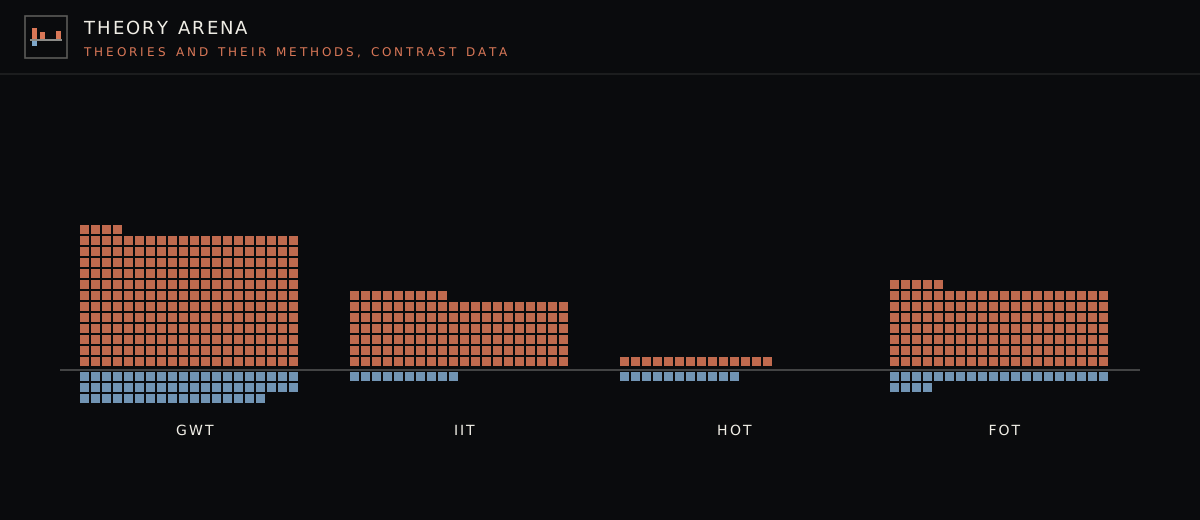
As a result, clinical coma diagnostics rarely incorporate formal models of visceral brain-heart effective connectivity, even though autonomic and brainstem-visceral loops often provide the earliest physiological signs of covert recovery. Readers can see how experimental methods partition across theories in our interactive Theory Arena Console, which maps more than 500 empirical consciousness studies from the ConTraSt database across GNW, IIT, Higher-Order Thought, and Recurrent Processing theories.
Indeed, recent work published this same week begins to close the exact gap that Meng, Laureys, and Ming identified. In Andrew Levy, Micah Allen, and Karl Friston’s November 2026 study on Embodied Dynamic Causal Modelling (Embodied DCM), simultaneous EEG and ECG recordings are inverted through a five-nucleus Brainstem Cardiac Network, offering an instrument that clinical Disorders of Consciousness cohorts can deploy directly at the bedside.
Comparison to The Consciousness AI
For The Consciousness AI, the three-path architecture revealed by 30 years of neuroscience literature validates the multi-layer design of our Core Architecture.
A recurring failure mode in computational consciousness projects is building exclusively inside Path 1 (constructing a Global Workspace broadcast bottleneck for external visual tokens) while ignoring Path 2 (internal homeostatic and interoceptive self-modeling) and Path 3 (active inference and whole-network dynamical integration). Our repository integrates all three trajectories into a single testable loop combining a Sensory Tectum and Recurrent State Space Model for environmental contents (Path 1), a Self-Model and Affective Core tracking internal homeostatic survival variables (Path 2), and oscillatory phase-coupling alongside perturbational complexity (PCI) propagation checks across modules (Path 3).
Where the Next Decade of Consciousness Neuroscience Is Heading
Meng, Laureys, Ming, and colleagues conclude that the fourth decade of consciousness neuroscience (2026 to 2035) will be defined by whether the field can weld its three trajectories together. Specifically, integrating bedside perturbational complexity metrics (PCI and high-density EEG in Disorders of Consciousness) with closed-loop interoceptive and brainstem autonomic physiology, while subjecting rival theoretical frameworks (GNW, IIT, Active Inference, and subcortical theories) to preregistered adversarial tests, offers the clearest path from fragmented citation clusters to a cumulative science of subjective experience.
Researchers covered here
- Qiangfan MengAcademy of Medical Engineering and Translational Medicine, Tianjin UniversityScientometric synthesis of three decades of consciousness neuroscience (1998-2025), co-citation and keyword burst mapping
- Steven LaureysComa Science Group, GIGA Consciousness, University of Liège and CERVO Brain Research Centre, Laval UniversityDisorders of consciousness, vegetative/unresponsive wakefulness syndrome vs. minimally conscious state, frontoparietal and default mode network neuroimaging
- Dong MingAcademy of Medical Engineering and Translational Medicine, Tianjin UniversityBrain-computer interfaces, neural engineering, scientometric synthesis of three decades of consciousness research