


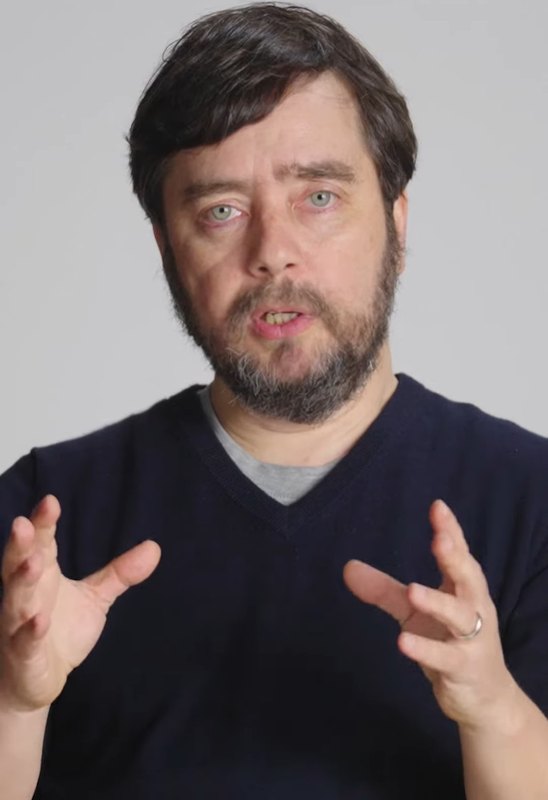
Douglas Blackiston
Allen Discovery Center at Tufts University
Biological naturalist Consciousness requires living metabolic hardware
Douglas Blackiston is a developmental biologist at Tufts University’s Allen Discovery Center whose work spans the two ends of the bioelectric cognition program. On the memory side, his 2015 review with Tal Shomrat and Michael Levin surveyed memory stability during brain remodeling, covering planarian regeneration, brain transplantation in amphibians, and the general phenomenon of learned information that outlives the nervous system that originally held it. The review, examined on this site in the bioelectric memory analysis, gave the planarian result its general form, memory storage distributed across the living body rather than confined to the brain.
On the synthetic side, Blackiston co-authored the xenobot papers, including the 2021 Science Robotics platform paper that characterized behavior and learning in reconfigurable living organisms built from frog cells. That line produced the designed living constructs in which the lab’s memory mechanisms can now be measured behaviorally, physiologically, and transcriptionally at once, the development the 2026 Pai preprint reports.
Blackiston’s dual role is relevant to this site’s questions. Memory that survives brain replacement is the biological existence proof that information relevant to an organism’s behavior can persist across substrate change, which is the biological half of the substrate independence debate the site runs from the machine side. His work supplies the evidence and, in the xenobot platform, the tool for intervening on it.
Known for. Memory stability during brain remodeling, xenobot platform design, amphibian memory transplantation work
Coverage on this site
Related researchers
-
 Michael LevinAllen Discovery Center, Tufts UniversityBioelectric signalling, the cognitive light cone, and diverse intelligence
- Tal ShomratTufts University (Levin laboratory)Automated planarian training, memory persistence through head regeneration, in vivo learning instrumentation
- Vaibhav PaiTufts University (Levin laboratory)Memory mechanisms in synthetic living constructs, bioelectric pattern control, xenobot lineage research
- František BaluškaUniversity of BonnCellular consciousness, subcellular nanobrains, plant neurobiology, sentient cells as units of physiology
- Tristan A. BekinschteinDepartment of Psychology / Consciousness and Cognition Lab, University of CambridgeClinical biomarkers of consciousness, local-global auditory paradigm, transitions from wakefulness to sedation, neural dynamics of awareness
- Tomas Berjaga-BuisanComputational Neuroscience Group, Center for Brain and Cognition, Universitat Pompeu Fabra, BarcelonaNon-equilibrium thermodynamics of whole-brain models, fluctuation-dissipation theorem violations as a non-invasive consciousness marker
Douglas Blackiston is listed with the other biological naturalists, who hold that consciousness requires living metabolic hardware. The theory family behind that position is set out in the index of consciousness theories. Every researcher covered on this site is indexed in the directory of consciousness researchers.