


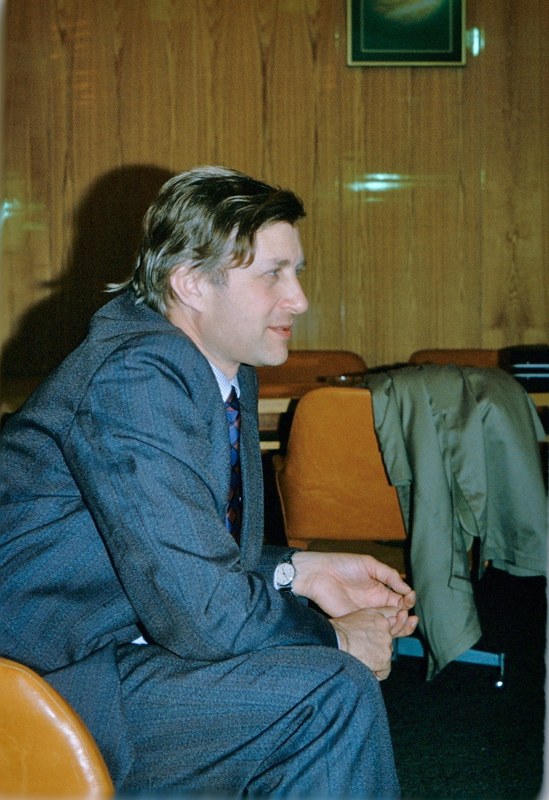
Nikolai Kardashev
Sternberg Astronomical Institute, Moscow State University, later the Russian Academy of Sciences
Cosmist Mind is not bound to the planet or the biology that produced it

Nikolai Kardashev was a Russian radio astronomer, born in 1932, who worked on quasars and cosmology before turning to the search for extraterrestrial intelligence. His 1964 paper on the transmission of information by extraterrestrial civilizations, in Soviet Astronomy AJ, volume 8, page 217, classified possible civilizations into three types by the power they command, presented at the 1964 Byurakan meeting in Armenia. The paper’s purpose was observational. A civilization far enough up the scale would be detectable at galactic distances with the instruments of the 1960s, so the scale was a proposal about where to point telescopes before it was a philosophy of history.
The numbers shifted in later use. Kardashev’s own estimates for the lower types were smaller, and the convention that followed, pressed forward by Carl Sagan’s 1973 formula, fixed Type I near 10 to the 16 W, Type II near 10 to the 26, and Type III near 10 to the 36. In that form the scale became the standard yardstick of every expansion program, cited across SETI, Dyson swarm proposals, and the 2026 launch of Kardashev Research, which took his name and his three levels as its frame.
The Cosmist placement records how the scale functions rather than a doctrine the man defended. Kardashev was an astronomer, and his scale says nothing about consciousness. Its work in this site’s argument is operational. Fyodorov supplied the obligation to expand and Tsiolkovsky the route, and Kardashev converted the program into a quantity a civilization could be measured against, watts captured per level. What the scale cannot say, which organization running on which substrate turns captured power into a mind, is the question substrate independence carries, and it is why the 1964 paper sits in the same lineage here as the two cosmists who preceded it.
Known for. The 1964 classification of civilizations by captured power, the Kardashev scale, and the Byurakan SETI meeting where it was presented
Coverage on this site
Related researchers
- Nikolai FyodorovRumyantsev Museum library, Moscow, from 1878The Philosophy of the Common Task, and space settlement as an obligation owed to the dead
- Konstantin TsiolkovskyKaluga, Russia. Self taught, and a schoolteacher for most of his working lifeThe theory of cosmic eras, and the claim that mind ends in a radiant form
- Maxwell J. D. RamsteadVERSES AI Research Lab, Los Angeles; Department of Philosophy, McGill UniversityMultiscale active inference, cultural affordances, computational neurophenomenology, shared intentionality
- Karl FristonUniversity College London. Chief Scientist, VERSES AIThe free energy principle and active inference
- Erik HoelCenter for Humanities and Sciences, Tufts UniversityFormal theory of Causal Emergence (macro over micro causation), The Overfitted Brain Hypothesis of Dreams, The World Behind the World (2023), The Kleiner-Hoel Dilemma
- Guillaume VerdonExtropic, San Francisco, founder. Kardashev Research, the nonprofit research initiative announced under the Beff Jezos pseudonymExtropic's thermodynamic computing hardware and the Z1 chip, the e/acc movement written under the Beff Jezos pseudonym, and the 2026 Kardashev Research launch
Nikolai Kardashev is listed with the other cosmists, who hold that mind is not bound to the planet or the biology that produced it. The positions themselves are set out in the index of consciousness theories. Every researcher covered on this site is indexed in the directory of consciousness researchers. The argument that mind can leave the planet that produced it is covered on Project Consciousness to Orbit.