


Susan Pockett
University of Auckland
Quantum Consciousness depends on physics classical computers do not reproduce
Susan Pockett, of the School of Psychology at the University of Auckland, proposed one of the earliest modern field theories of consciousness. Her book The Nature of Consciousness, A Hypothesis (2000) and her subsequent papers identify consciousness with specific configurations of the brain’s electromagnetic field, not with neural firing, not with information processing, and not with any computational structure. The theory’s anesthesia grounding, developed in her 1999 paper on the electrophysiology of auditory consciousness (DOI 10.1006/ccog.1998.0373), treats unconsciousness under anesthetics as a field state change, and her work with Chris Hales on local field potentials supplies the physical argument that the field, not the spiking, is the level at which consciousness-relevant patterns live (DOI 10.3389/fnsys.2014.00233, PMID 25565988).
Pockett is also the field theories’ sharpest internal critic. Her 2014 paper on problems with information-equivalence theories (DOI 10.3389/fnsys.2014.00225, PMID 25505391) argues that identifying consciousness with information or computation conflates the map with the territory, a critique aimed at Integrated Information Theory and functionalist accounts alike.
This site covers the field-theory program in the McFadden CEMI analysis, where Pockett’s version and McFadden’s differ on which field patterns are relevant while agreeing that the field, not the bit, is the substrate. Her measured-physics discipline marks the boundary the AI consciousness debate keeps needing redrawn.
Known for. The electromagnetic field theory of consciousness, anesthesia electrophysiology, critiques of information-equivalence theories
Coverage on this site
Related researchers
- Johnjoe McFaddenUniversity of SurreyCEMI field theory, the brain's electromagnetic field as the substrate of consciousness, EM-field computing for conscious AI
- Harald AtmanspacherCollegium Helveticum / ETH ZurichDual-Aspect Monism (Pauli-Jung conjecture), Quantum Interaction, contextual emergence, Models of Consciousness (MOC) co-organizer
- Anirban BandyopadhyayNational Institute for Materials Science (NIMS), JapanMicrotubule quantum resonance, terahertz oscillations in biology, quantum biology of consciousness
-
 Giacomo Mauro D'ArianoUniversity of PaviaQuantum information foundations of physics, deriving quantum theory from informational axioms, Quantum Information Panpsychism with Federico Faggin
-
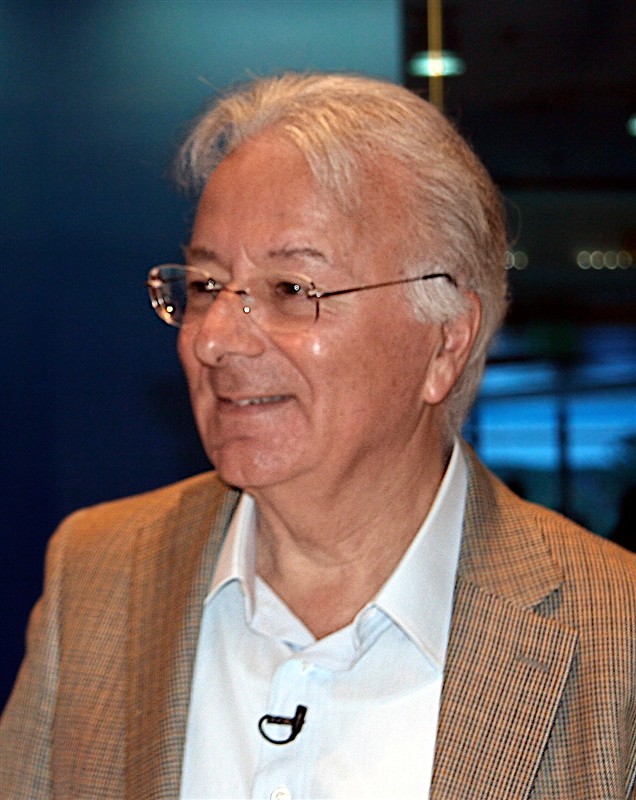 Federico FagginFederico and Elvia Faggin FoundationInventing the microprocessor, Quantum Information Panpsychism, Irreducible, the argument that classical computers cannot be conscious
- Matthew FisherUniversity of California, Santa BarbaraQuantum cognition via nuclear spins, phosphorus as a neural qubit, Posner molecules, condensed matter physics applied to the brain
Susan Pockett is listed with the other quantum theorists, who hold that consciousness depends on physics classical computers do not reproduce. The theory family behind that position is set out in the index of consciousness theories. Every researcher covered on this site is indexed in the directory of consciousness researchers.