


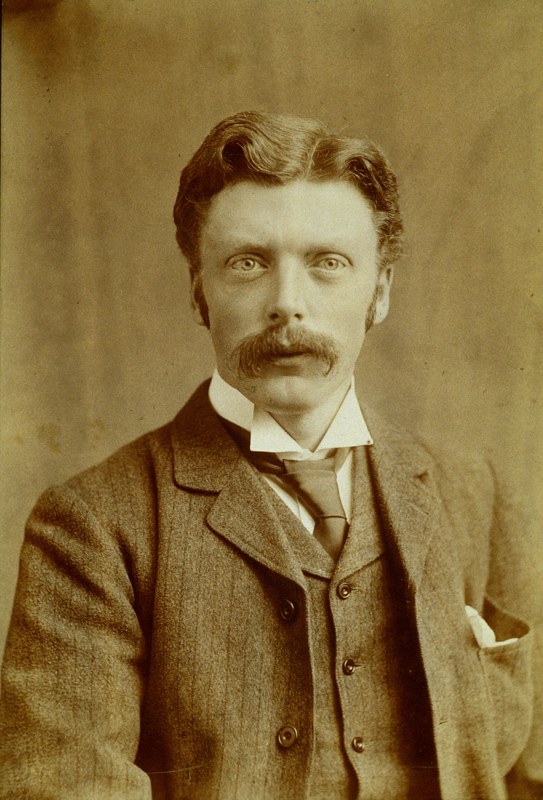
D'Arcy Wentworth Thompson
University of St Andrews
Biological naturalist Consciousness requires living metabolic hardware

Position on AI consciousness
Thompson did not write about artificial minds, yet his thesis that physical geometry and energy landscapes constrain biological form directly underpins modern substrate-independent models of morphogenesis and self-organization.
D’Arcy Wentworth Thompson challenged early twentieth-century biology by arguing that natural selection alone cannot explain why living organisms take the shapes they do. In On Growth and Form (1917, revised 1942), he treated cells, shells, skeletons, and tissues as physical systems governed by surface tension, mechanical stress, diffusion, and coordinate transformations.
His structuralist perspective became an intellectual anchor for developmental bioelectricity and mathematical biology. Researchers such as Michael Levin, Alan Turing, and Hans Meinhardt drew on Thompson’s core premise that living matter exploits physical laws as free computational resources rather than encoding every anatomical detail explicitly in genes.
For consciousness science, Thompson’s work illustrates a foundational principle of emergent organization. Complex biological order arises from the interplay between physical constraints and living dynamics, a point that bears directly on whether cognitive architecture is locked to one biochemical lineage or can emerge across different physical substrates.
Known for. On Growth and Form, mathematical morphogenesis, and physical constraints on biological form
Coverage on this site
Related researchers
- František BaluškaUniversity of BonnCellular consciousness, subcellular nanobrains, plant neurobiology, sentient cells as units of physiology
- Mark BaronDepartment of Neurology, Beth Israel Deaconess Medical Center and Harvard Medical SchoolBrainstem Theory of Consciousness, subcortical mechanisms of wakefulness, pain, and anesthesia with Marshall Devor
- Robert O. BeckerSUNY Upstate Medical University and Veterans Administration Hospital, SyracuseElectromagnetism and Life, direct-current control systems, and electrical stimulation of limb regeneration
- Tristan A. BekinschteinDepartment of Psychology / Consciousness and Cognition Lab, University of CambridgeClinical biomarkers of consciousness, local-global auditory paradigm, transitions from wakefulness to sedation, neural dynamics of awareness
- Tomas Berjaga-BuisanComputational Neuroscience Group, Center for Brain and Cognition, Universitat Pompeu Fabra, BarcelonaNon-equilibrium thermodynamics of whole-brain models, fluctuation-dissipation theorem violations as a non-invasive consciousness marker
- J. Mark BishopGoldsmiths, University of LondonDancing with Pixies argument, critique of computational functionalism, From Maps to Metabolism (2026)
D'Arcy Wentworth Thompson is listed with the other biological naturalists, who hold that consciousness requires living metabolic hardware. The theory family behind that position is set out in the index of consciousness theories. Every researcher covered on this site is indexed in the directory of consciousness researchers.