



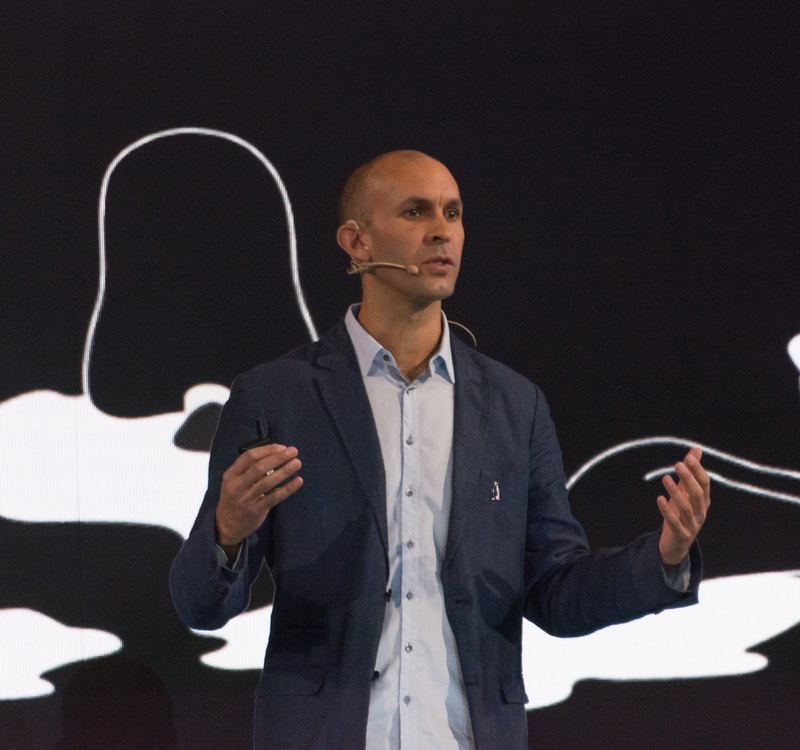
Sergiu Pașca
Stanford University
Biological naturalist Consciousness requires living metabolic hardware
Sergiu Pașca is a professor at Stanford University, where he leads the Brain Organogenesis program. His laboratory develops human stem-cell-derived neural systems, including self-organizing three-dimensional cortical organoids and assembled multi-region constructs, as models of human brain development and disease.
The laboratory’s 2026 Nature paper, “Developmental xenocortication using human-derived organoids in mice”, published on September 16 with Konstantin Kaganovsky and Kevin W. Kelley as lead authors (DOI 10.1038/s41586-026-11032-2), introduced the xenocortical mouse platform. The method depletes the mouse cortex and hippocampus of glutamatergic neurons and engrafts human cortical organoids into the cavity, producing animals whose cortical volume is largely human tissue with organized, developing-circuit-like activity, integration with the host nervous system, and measurable behavioral consequences.
For consciousness science the platform is a new instrument on the substrate question. It places organized human neural tissue inside a behaving animal, which brackets the minimum-organizing-principle debate between the culture-based systems such as Brainoware and whole brains, and it supplies the empirical base for the welfare roadmap from Nita Farahany and Anil Seth. The organoid consciousness criteria debate is the framework the platform’s readouts will test.
Known for. Human cortical organoids and assembloids, the Brain Organogenesis program, xenocortical mice
Coverage on this site
- Xenocortical Mice Put Human Cortical Tissue in Mouse Brains and Raise Welfare Questions September 2026
Related researchers
-
 Anil SethSussex Centre for Consciousness Science, University of SussexThe beast machine hypothesis, and controlled hallucination as an account of perception
- Nita FarahanyDuke Initiative for Science and Society, Duke UniversityThe Battle for Your Brain (2023), cognitive liberty and mental privacy, co-founder and co-editor-in-chief of the Journal of Law and the Biosciences, UNESCO neurotechnology ethics co-chair
- František BaluškaUniversity of BonnCellular consciousness, subcellular nanobrains, plant neurobiology, sentient cells as units of physiology
- Tristan A. BekinschteinDepartment of Psychology / Consciousness and Cognition Lab, University of CambridgeClinical biomarkers of consciousness, local-global auditory paradigm, transitions from wakefulness to sedation, neural dynamics of awareness
- Tomas Berjaga-BuisanComputational Neuroscience Group, Center for Brain and Cognition, Universitat Pompeu Fabra, BarcelonaNon-equilibrium thermodynamics of whole-brain models, fluctuation-dissipation theorem violations as a non-invasive consciousness marker
- Douglas BlackistonAllen Discovery Center at Tufts UniversityMemory stability during brain remodeling, xenobot platform design, amphibian memory transplantation work
Sergiu Pașca is listed with the other biological naturalists, who hold that consciousness requires living metabolic hardware. The theory family behind that position is set out in the index of consciousness theories. Every researcher covered on this site is indexed in the directory of consciousness researchers.