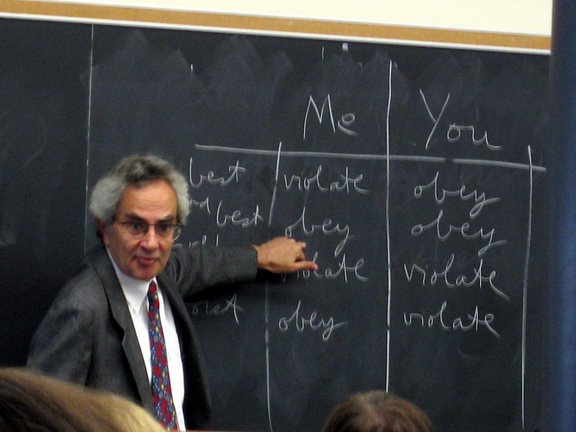
Thomas Nagel
New York University
Biological naturalist Consciousness requires living metabolic hardware
.jpg)
Thomas Nagel gave contemporary philosophy of mind its defining criterion of phenomenal consciousness. In his seminal 1974 paper “What Is It Like to Be a Bat?” (The Philosophical Review, DOI: 10.2307/2183914), he argued that an organism is conscious if and only if there is “something that it is like” to be that organism, an irreducible subjective, first-person character of experience.
Nagel’s position challenges purely objective, third-person physicalist and functionalist accounts. Because human sensory experience is grounded in vision and hearing, humans cannot comprehend the subjective point of view of a bat’s echolocation system, even with a complete physical description of its neurophysiology.
In Mind and Cosmos (Oxford University Press, 2012, ISBN 978-0-19-991975-8), Nagel extended this critique to evolutionary materialist reductionism, arguing that a complete scientific understanding of nature must account for consciousness as a fundamental feature of reality rather than an accidental byproduct of physical complexity.
Known for. What Is It Like to Be a Bat? (1974), the subjective character of experience, and Mind and Cosmos (2012)
Coverage on this site
Related researchers
- František BaluškaUniversity of BonnCellular consciousness, subcellular nanobrains, plant neurobiology, sentient cells as units of physiology
- Tristan A. BekinschteinDepartment of Psychology / Consciousness and Cognition Lab, University of CambridgeClinical biomarkers of consciousness, local-global auditory paradigm, transitions from wakefulness to sedation, neural dynamics of awareness
- Tomas Berjaga-BuisanComputational Neuroscience Group, Center for Brain and Cognition, Universitat Pompeu Fabra, BarcelonaNon-equilibrium thermodynamics of whole-brain models, fluctuation-dissipation theorem violations as a non-invasive consciousness marker
- Douglas BlackistonAllen Discovery Center at Tufts UniversityMemory stability during brain remodeling, xenobot platform design, amphibian memory transplantation work
- Scott L. BrincatPicower Institute for Learning and Memory, MITElectrophysiology of primate prefrontal cortex, traveling oscillatory waves, and Analog Cognition and Consciousness (2026)
- Paco CalvoUniversity of MurciaPlant cognition and plant neurobiology, minimal cognition without neurons, Planta Sapiens, cognitive ecology of plants
Thomas Nagel is listed with the other biological naturalists, who hold that consciousness requires living metabolic hardware. The theory family behind that position is set out in the index of consciousness theories. Every researcher covered on this site is indexed in the directory of consciousness researchers.