


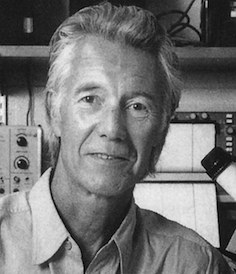
Brian Goodwin
University of Sussex, Open University, and Schumacher College
Biological naturalist Consciousness requires living metabolic hardware

Position on AI consciousness
Goodwin insisted that biological form emerges from relational field dynamics rather than isolated genetic instructions, anticipating modern models of collective cellular cognition and non-neural agency.
Brian C. Goodwin (1931-2009) was a Canadian-born theoretical biologist who worked at the University of Sussex, the Open University, and Schumacher College, and served as a founding member of the Santa Fe Institute. Trained under C. H. Waddington, Goodwin became a leading voice in process structuralism, arguing that living anatomy is generated by lawful, self-organizing morphogenetic fields rather than solely by historical accidents accumulated through natural selection.
Together with Nigel Holder and C. C. Wylie, Goodwin edited Development and Evolution (Cambridge University Press, 1983), and he published foundational field-theoretic models of the giant single-celled marine alga Acetabularia alongside studies of ionic calcium-cytoskeletal oscillations in embryonic cleavage. In those models, genes supply material parameters while spatial fields solve the actual geometric problem of form.
Goodwin’s intellectual lineage runs directly from D’Arcy Wentworth Thompson and Joseph Needham into twenty-first-century developmental bioelectricity, where resting voltage prepatterns instantiate the exact relational fields Goodwin sought to formalize.
Known for. Morphogenetic fields, structuralist biology, and dynamic self-organization in morphogenesis
Coverage on this site
Related researchers
- František BaluškaUniversity of BonnCellular consciousness, subcellular nanobrains, plant neurobiology, sentient cells as units of physiology
- Mark BaronDepartment of Neurology, Beth Israel Deaconess Medical Center and Harvard Medical SchoolBrainstem Theory of Consciousness, subcortical mechanisms of wakefulness, pain, and anesthesia with Marshall Devor
- Robert O. BeckerSUNY Upstate Medical University and Veterans Administration Hospital, SyracuseElectromagnetism and Life, direct-current control systems, and electrical stimulation of limb regeneration
- Tristan A. BekinschteinDepartment of Psychology / Consciousness and Cognition Lab, University of CambridgeClinical biomarkers of consciousness, local-global auditory paradigm, transitions from wakefulness to sedation, neural dynamics of awareness
- Tomas Berjaga-BuisanComputational Neuroscience Group, Center for Brain and Cognition, Universitat Pompeu Fabra, BarcelonaNon-equilibrium thermodynamics of whole-brain models, fluctuation-dissipation theorem violations as a non-invasive consciousness marker
- J. Mark BishopGoldsmiths, University of LondonDancing with Pixies argument, critique of computational functionalism, From Maps to Metabolism (2026)
Brian Goodwin is listed with the other biological naturalists, who hold that consciousness requires living metabolic hardware. The theory family behind that position is set out in the index of consciousness theories. Every researcher covered on this site is indexed in the directory of consciousness researchers.