

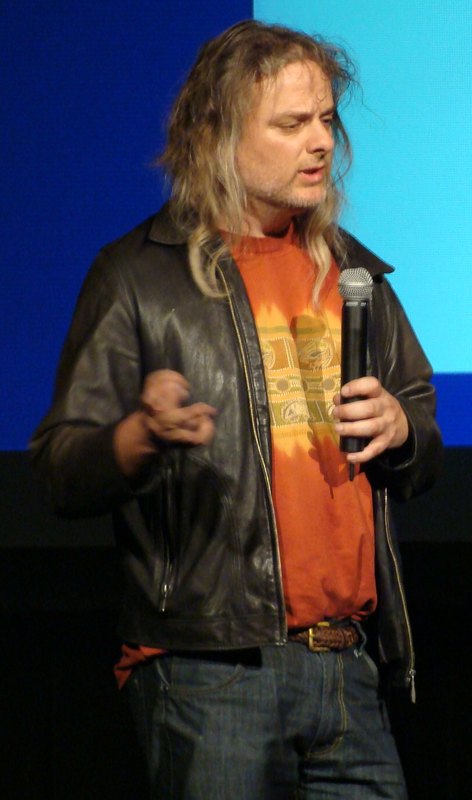
David Chalmers
New York University. Co-director, Center for Mind, Brain and Consciousness
Functionalist What matters is the organisation of the processing, not the material

Position on AI consciousness
Chalmers holds that consciousness is not obviously tied to biology and that a system with the right organisation could be conscious. He puts current language models at probably not conscious, while arguing that the reasons for confidence are weaker than people assume.
David Chalmers gave the field its central problem and its vocabulary. The hard problem is the question of why physical processing is accompanied by experience at all, as distinct from the easy problems of explaining discrimination, integration, reportability and control. Those easy problems are hard in the ordinary sense and will yield to normal science. The hard one is different in kind, because a complete functional account leaves the question untouched.
His position on artificial systems follows from that and is more permissive than his reputation suggests. Chalmers holds that consciousness is not obviously tied to biology, that a system with the right organisation could be conscious, and that current language models probably are not but that the reasons for confidence are weaker than people assume. He has put explicit probabilities on it rather than asserting a verdict, which is unusual and useful.
The caution he urges is epistemic. We are poor judges of which systems are conscious, our intuitions were shaped by encountering only biological minds, and a system trained on human text is optimised to produce exactly the signals those intuitions respond to. That is a different worry from the claim that machines cannot be conscious, and the two are frequently conflated.
Known for. Naming the hard problem of consciousness, and the philosophical zombie argument
Coverage on this site
Research Papers and Preprints
- Dreaming and Consciousness From David Foulkes to World Models September 2026
- David Chalmers and Andy Han Find Reinforcement Learning Recruits a Functional Welfare Axis in Language Models September 2026
- David Chalmers Moral Weight and the Probability of LLM Sentience in 2026 August 2026
- Anil Seth Mythology of Conscious AI Biological Naturalism Berggruen Prize Essay August 2026
- Andy Clark's Predictive Processing Framework and What It Actually Implies for LLMs July 2026
- What AI Researchers Actually Believe About AI Subjective Experience July 2026
- The Zombie Gap in AI Consciousness Where 2026 Biological Naturalism Research Draws the Line June 2026
- Emergent Language as an Approach to Conscious AI and A Generative Methodology from Osaka June 2026
- Belief Formation and Meta-Cognitive Monitoring in LLMs and Empirical Support for the HOT-3 Consciousness Indicator June 2026
- Chalmers on LLMs Virtual Entities, Quasi-Agency, and the Question of AI Welfare May 2026
- Consciousness Indicators, Mimicry, and the Problem of Internal Variants May 2026
- The Calibration Problem Why AI Consciousness Indicators Need Biological Grounding May 2026
- Can We Validate AI Consciousness Indicators? The Hard Problem Behind the Checklist April 2026
- What Would AI Consciousness Actually Look Like? The 14-Indicator Checklist Explained March 2026
- Chalmers on Gradual Uploading and Why It Counts as Survival June 2025
- Organizational Invariance and the Fading Qualia Argument June 2025
Books and Monographs
Keynotes and Event Talks
Articles and Commentary
Related researchers
- David FoulkesDevelopmental research on children's dream reports and narrative dreaming
-
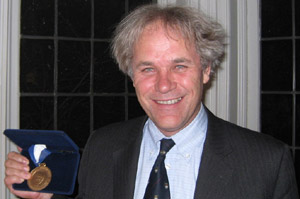 Mark SolmsUniversity of Cape TownNeuropsychoanalysis, and the brainstem account of affective consciousness
- Erik HoelCenter for Humanities and Sciences, Tufts UniversityFormal theory of Causal Emergence (macro over micro causation), The Overfitted Brain Hypothesis of Dreams, The World Behind the World (2023), The Kleiner-Hoel Dilemma
- John R. SearleUniversity of California, BerkeleyThe Chinese Room Argument (1980), Biological Naturalism, Syntax is not semantics, The Rediscovery of the Mind (1992)
- Andy Q. HanCenter for Mind, Brain and Consciousness, New York UniversityMechanistic interpretability of welfare representations, concept steering in language models, functional welfare axes in reinforcement learning
- Pavel IzmailovCourant Institute of Mathematical Sciences, New York UniversityStochastic Weight Averaging (SWA), Bayesian deep learning, loss surface geometry, representation engineering in language models
David Chalmers is listed with the other functionalists and computationalists, who hold that what matters is the organisation of the processing, not the material. The theory family behind that position is set out in the index of consciousness theories. Every researcher covered on this site is indexed in the directory of consciousness researchers.